I’ll be giving this talk later this week. Here are the first few paragraphs (please forgive a few still-to-be-corrected typos). Opening Section of PI and Three Kinds of Illusion
Category Archives: Philosophy
In Spite of Death and the Devil: Husserl–Diary Entry, 9/25/1906
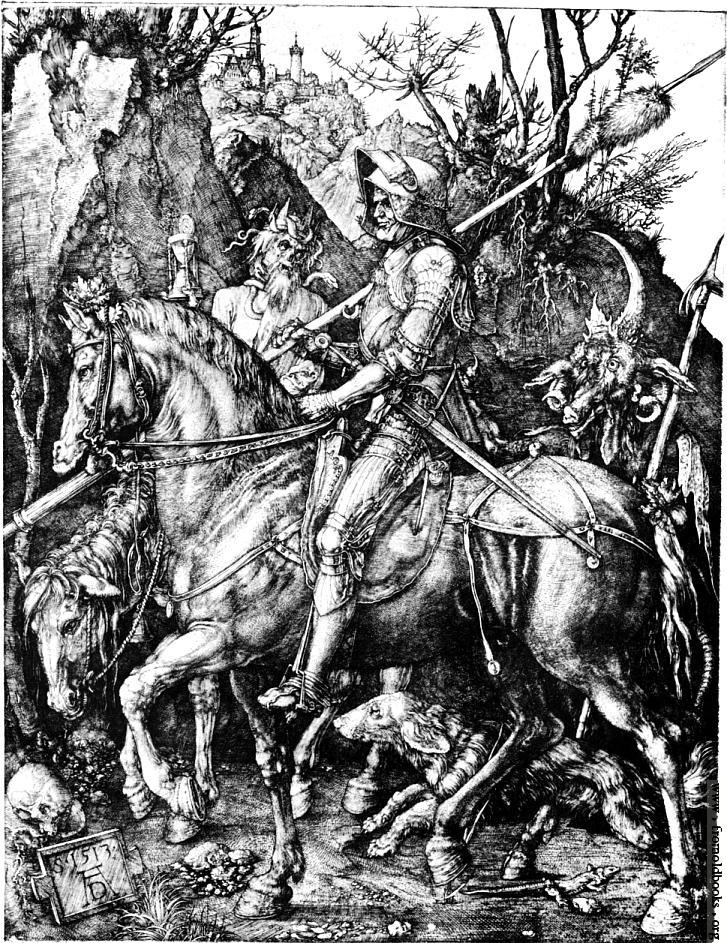
Pure meditation, pure internal life, being absorbed by the problems and devoting myself to them, and to them only, that is the hope of my future. If I do not succeed, then I shall have to live a life which is rather death.
…I have to pursue my way so surely, so firmly, so decidedly, and so in earnest as Dürer’s Knight in spite of Death and the Devil…And be God with me in spite of the fact that we are all sinners!
And So Husserl Goes…
(from a seminar handout)
As I said last time, Husserl starts, starts and starts again, and again, tracing and retracing his steps. He makes a set of phenomenological distinctions and elucidates them. During the elucidation, the need for a new set of more finely drawn phenomenological distinctions becomes clear. Husserl then retreats and starts over; he retraces his former path, but now with even more-mincing steps. Sometimes, the former distinctions are overthrown in favor of the latter, sometimes they are kept, but as as marking the gross phenomenological anatomy, and requiring finer phenomenological anatomizing. And so Husserl goes, back and forth, starting over and over, a beginner among beginners. Husserlian phenomenology is a race to the starting line.
Maxim Stolen from Josh Blog
Point out what’s not hidden.
Early Days of Phenomenology
Sticky, drizzly and grey here in the heart of Dixie. I am struggling to get my courses off the ground. I so hate the first few days of class, those days where I am aware of myself, the students seem aware of themselves and we together struggle to turn our awareness to the material at hand. I like it when the material takes over and we all can forget ourselves in it, in a focused, teamworky way. As usual, I am finding the first days of Phenomenology particularly difficult. (If anyone out there has created some particularly graceful, hardly-disturbs-the-water dive into Phenomenology, I’d be most eager to know about it.) The trouble, as I see it, is that there are several different dimensions of difficulty and you need to make progress on them all, sorta simultaneously. There’s the Reduction, of course, but there is also the threat/problem of psychologism, and it is hard to see how to understand either of those aright without understanding the other–and, of course, there is the ubiquitous, term-long fight to distinguish Phenomenology from Phenomenalism, and that too is bound up with explanation of the Reduction and the threat/problem of psychologism.
At the moment, we are reading Frege–his review of Husserl’s book on arithmetic and his seminal “The Thought”. I use the distinctions among the Three Realms as a way of making progress on these topics (the Reduction, etc.), although the Realms have to be used dialectically, dropped after they’ve done their job, since they do not really quite work. The basic strategy is to distinguish the Realms and their denizens–physical objects, ideas and thoughts–and then to distinguish the intentional object of a particular case of perception from the intentio of that perception, pointing out that the intentional object is a denizen of the Outer Realm (a tree, say) and then asking whether the intentio seems more like a denizen of the Inner Realm (an idea) or like a denizen of the Third Realm (a thought). Now, the intentio strictly speaking seems misfit as a denizen of either, but considering it as a denizen of the Inner Realm helps the students to understand psychologism, and why it is a threat/problem for phenomenology, and considering it as a denizen of the Third Realm helps to make sense of the claim that what the Reduction discloses is something essential and, in some way, objective–or at least not subjective as ideas are subjective. The heart of the strategy is to get the students to begin really to struggle with the worry about whether what the Reduction discloses is something that is existentially mind-dependent (ideas) or not existentially mind-dependent (physical objects or thoughts), or whether there is some other way of trying to understand what is disclosed.
Final Paragraphs of New Talk: Philosophical Investigations
[I’m unsure how much sense these paragraphs make without the preceding 15 pages or so. First draft material.]
Allow me to reiterate my thinking about the three illusions in PI As I have said, I think that transcendental illusions are central to PI, central to understanding its conception of philosophical problems. But I do not mean to deny that the other two types of illusion make appearances in PI. They do. If they didn’t, the other two readings of PI I have discussed would probably never have tempted anyone. But I do not think either of those other two illusions is central in the way transcendental illusion is central. Even more, although I do not have time to detail this now, I also think that the other two types of illusion can metastasize into transcendental illusions, and that what seems merely an empirical or logical illusion can itself be revealed to be or involve a transcendental illusion.
Still, I suspect at this point that you may be less interested in this nicety of housekeeping and more interested in the spirit-sinking midwinter bleakness of the picture of philosophical problems that I have been presenting. Haven’t I said that philosophical problems don’t get solved? —Yes. Haven’t I said that the best we can hope for is to cope with them, and that only temporarily? —Yes. Isn’t that an incredible downer? —Yes. —No. —Yes and no.
Let me revert to Kant once more, while also recalling my opening remarks. At least from his early 20’s, Kant is vexed by the uncanny fact that for so long and so often philosophers of equal education and gifts, each deeply serious and sincere, persist in apparently irreconcilable conflict. Kant regards this as a disgrace to reason. We can think of Kant’s entire philosophical career as driven by his passionate concern to settle conflicts in philosophy—not by entering a judgment in favor of either of the conflicting philosophers, but rather by entering a judgment on the conflict itself, by finding a way to end it. Kant first pictured these conflicts as between philosophers; but he later came to picture them as conflicts between arguments; and still later he came to picture them as reason in conflict with itself, as reason having fallen out of agreement with itself. This became Kant’s new picture of the uncanny fact: reason can fall into apparently irreconcilable conflict with itself.
Wittgenstein we can think of as accepting and, in a sense, extending this movement of Kant’s. He comes to see philosophical problems as manifesting my having fallen out of agreement with myself. It is this uncanny fact about me—and about you too of course—that is the mainspring of PI. Philosophical problems are all at once conceptual, i.e., invulnerable to the empirical, and also deeply personal, personal in the sense that I am at stake in them in various ways, personal in the sense that the problems encroach upon me. My desires and longings, my needs and fears, –my whole affective being potentially is part of the problem. Because it is, we cannot take a simply objective approach to the problems. We must instead always and everywhere approach the problem subjectively, attending to our mode of involvement in it. And there is always already one of those whenever we reflect on a philosophical problem. (Reflecting on a philosophical problem is not an empty holding of something, of the problem.) I am a part of, involved in, every philosophical problem that I take up, like it or not. You too are part of every philosophical problem you take up. The mode of involvement in the problem matters and is, in fact, itself a part of the problem. When we see this, we are also position so as to see what PI is showing each of us: I am susceptible to transcendental illusion. I can, with practice, develop a discipline of response to such illusions. I can teach myself—-with the aid of PI—-to push back against the pressures of transcendental illusion, to stick to ordinary realities. But learning this discipline neither ends philosophy itself for me nor ends any philosophical problem permanently. I have to recognize that I am tempted and I need to find a way of responding to the temptation other than yielding to it. And I have to recognize that there is no way simply to end temptation. I should expect to be tempted until my last breath. But none of this makes much sense if we think that philosophical problems can be independent of modes of reception. To care about illusion as Wittgenstein does is to care about modes of involvement and vice-versa: To use `illusion’ as a term of criticism as Wittgenstein does is to bring the mode of involvement in a philosophical problem into work on the problem.
Philosophy, as Wittgenstein teaches it to us in PI, is transcendental dialectic, but Wittgenstein’s transcendental dialectic is self-critique. Philosophy is self-critique. Philosophy is a form of self-knowledge. Is that a downer? No: there is philosophy to be done. There is always philosophy to be done. Self-critique has no endgame. Even more, there is progress of a sort that can be made. I can become better at resisting temptation, better at recognizing its onset; I can discipline myself to push back harder and for longer and with better focus. That is, I can come better to know myself in such a way that I become better at controlling myself. I cannot make myself impassible, invulnerable to temptation. But I can respond to it better, yield to it less often or less easily. Still, isn’t that a downer? Yes: since such self-knowledge is, face it, almost always bitter. (What I discover will not be things of which I have been ignorant, simply epistemically blank, but things I have refused to know, to acknowledge.) We would all rather not do philosophy as self-examination, self-critique. We would rather do it as distinct from the self, as objective investigation in which my self does not count. We would like to be the investigators of the investigation but not the investigated. We want to be neither shaken nor stirred.
One quick parting comment: We can understand the similarity and difference between Kant and Wittgenstein and their transcendental dialectics in this memorable way, even if it may be slightly misleading: for Kant, we see things aright philosophically when we come to see that the solutions to philosophical problems must be transcendental idealist solutions. For Wittgenstein, we become what we need to be philosophically when we become `transcendental idealists’ about the problems themselves. Wittgenstein’s Copernican Revolution (PI 108) revolves the problems—and, thus revolved, we can see past the apparent need for a solution to them. So, since I have been talking about downers, let me end with a hurrah: Vive la revolution!
Gass on Philosophy as a Vocation
There are a few vocations (like the practice of poetry or the profession of philosophy) that are so uncalled for by the world, so unremunerative by any ordinary standards, so inherently difficult, so undefined, that to choose them suggests that more lies behind the choice than a little encouraging talent and a few romantic ideals. To persevere in such a severe and unrewarding course requires the mobilization of the entire personality–each weakness as well as each strength, each quirk as well as every normality. For any one of the reasons that a philosopher offers to support that principle he has taken in to feed and fatten, there will be in action alongside it, sometime in the shade of the great notion itself, coarse and brutal causes in frequently stunning numbers, causes with a notable lack of altruism and nobility, causes with shameful aims and antecedents. This has to be understood and accepted. Valery’s belief that every philosophy is an important piece of its author’s autobiography need not be rejected as reductive; for whatever the subliminal causes and their kind are like, the principle must stand and defend itself like a tree against the wind; it must make its own way out into who knows what other fields of intelligence, to fall or flourish there. –“At Death’s Door: Wittgenstein”
Always Worth a Read: Lucian’s The Sale of Creeds
Turning East–New Book

Just out from SVS Press. I contributed an essay.
From a Handout: Socrates as Midwife (Philosophical Questions 7)
[This was a class focused on Plato’s Theaetetus, Wittgenstein’s Blue Book and Bouwsma’s John Locke Lectures (The Flux). The class was entitled, “The Flux”. I taught it in the Spring of 1996.]
Back, now, to midwifery.
I recommend that Socrates be seen as logically clarifying thoughts. His interlocutor says something–provides the datum clarificandum–and Socrates goes to work. He pulls the interlocutor’s saying this way and that. He compares it with first one sentence and then another. All the while he’s asking his interlocutor to decide: “Is this what you meant? Could you have meant this?” Sometimes the interlocutor keeps up for a while.
What is the midwifery comparison? Call it an exhibitive theory of philosophizing. It shows us things we already know, but in a way that makes us see them afresh.
Socrates pictures his interlocutors as pregnant. The have something inside them, although there is no way of knowing whether what’s inside them is going to be viable or still-born. Socrates brings on labor pains. He does this, I guess, by administering a potent medicine, by asking “What is x?” Upon hearing the question, the interlocutor goes into labor. The labor, like all labor, is painful. (Try giving birth to Truth!) Why is it painful? Answering a question like “What is knowledge?” is a strenuous and hurtful mental business.
Let me try this without the midwifery idom.
Socrates knows how to ask questions. The questions he knows how to ask are not of the “What’s his name?” or “What sort of architecture is that?” variety. Such questions are not one that we are full of answers to, or think we are. Sometimes we can answer them; sometimes we can’t. As long as we aren’t taking a test or on Jeopardy, not being able to answer doesn’t matter much. But when we can’t answer Socrates’ questions, it matters. No test, no Jeopardy. Socrates asks, “What is knowledge?” and we think we have to answer. Why? –We all know that we know what knowledge is. That’s why! We all talk about knowledge, use “know” or its cognates, all the time.
Theaetetus is a learner. Theodorus is a teacher. Surely, they know what knowledge is.
Socrates askes “What is knowledge?” and we have an answer in us. But the answer won’t come quickly. Augustine: “If no one ask of me, I know; if I wish to explain to him who asks, I know not.” So we huff and we puff and we try things out: knowledge is perception. Knowledge is true judgment. None of these comes easily. We have the feeling that we force each out. The forcing hurts; it ought to be unnecessary. Socrates helps, if that is what he chooses to do, by asking still more questions. Each time we force out another answer, Socrates tests it. If it won’t do, he shows us it won’t. This is no fun, either. After all that work, after all those words, no one wants to see an apparent new answer, apparently fresh to the world and apparently full of promise, turn out to be nonsense–a phantom answer. Don’t rob us of our darling follies! But Socrates is a pro. He’s on a mission from God. He show us. Sometimes we go back to work forcing out another answer. Sometimes we take our phantoms and go home.
Socrates says he can tell those who are full of answers from those who aren’t. Those who aren’t he sends to Prodicus. (Prodicus has an office in our English department.) The others he helps. They profit from this help, even if they manage no viable births. How?
All this is strange. Midwifery is no glamorous role for the philosopher. He’s only around to help bring answers to light and to get rid of them, if they are monstrosities. (Philosophy: confusiasm over abstrocities.) The role is thoroughly negative. The philosopher is barren, has no answers of his own. He can’t adopt.
No pitter-patter of little answer-feet in the philosopher’s house.
 Quantum Est In Rebus Inane