Teaching Philosophy, Honestly

As best I can recall, Wittgensten wrote a short letter to Norman Malcolm when Malcolm earned his Ph. D.  It went something like this:

Congratulations to your PhD.  And now may you cheat neither yourself nor your students.  Because, unless I am very much mistaken, that is what will be expected of you.

There may have been a bit more.  My memory fails me.  But just this touches the problem.  How can you teach without cheating yourself or your students?  Exasperated a little by my students, I wrote to them today and said:

You have to decide:  do you want an education–a real education, or do you just want a diploma?  And if you just want a diploma, go and get it in someone else’s class, please:  I don’t care a whit about your diploma.  But I do care about your education.

The problem here is a kind of knot.  Our students all too often want us to cheat them, or are willing to let us; and we all too often want them to want us to cheat them, or are willing to let them want us to cheat them, or be willing to let us cheat them.  And so it goes.

Plato on The What and the How (but Especially the How)

…[I]t is barely possible for knowledge to be engendered of an object naturally good, in a man naturally good; but if his nature is defective, as is that of most men, for the acquisition of knowledge and the so-called virtues, and if the qualities he has have been corrupted, then not even Lynceus could make such a man see.  In short, neither quickness of learning nor a good memory can make a man see when his nature is not akin to the object, for this knowledge never takes root in an alien nature; so that no man who is not naturally inclined and akin to justice and all other forms of excellence, even though he may be quick at learning and remembering this and that and other things, nor any man who though akin to justice, is slow at learning and forgetful, will ever attain the truth that is attainable about virtue.  Nor about vice, either, for these must be learned together, just as the truth and error about any part of being must be learned together, through long and earnest labor…Only when all of these [instruments]–names, definitions, and visual and other perception–have been rubbed against one another and tested, pupil and teacher asking and answering questions in good will and without envy–only then, when reason and knowledge are at the very extremity of human effort, can the illuminate the nature of any object.  (Seventh Letter, 334a-b)

Prologue to the Summa

Because the Master of Catholic Truth ought not only to teach
the proficient, but also to instruct beginners (according to the
Apostle: “As Unto Little Ones in Christ, I Gave You Milk to
Drink, Not Meat”—1 Cor. iii. 1, 2), we purpose in this book to
treat of whatever belongs to the Christian Religion, in such a way
as may tend to the instruction of beginners. We have considered
that students in this Science have not seldom been hampered by
what they have found written by other authors, partly on account
of the multiplication of useless questions, articles, and arguments;
partly also because those things that are needful for them to know
are not taught according to the order of the subject-matter, but
according as the plan of the book might require, or the occasion
of the argument offer; partly, too, because frequent repetition
brought weariness and confusion to the minds of the readers.
Endeavoring to avoid these and other like faults, we shall try,
by God’s help, to set forth whatever is included in this Sacred Science
as briefly and clearly as the matter itself may allow.

Taking it Personally

(A piece of protreptic for my Seven Deadly Sins students.)

I know some of you are struggling with the Aquinas.  That is to be expected; it is hard.  But too many of you have, I worry, lost sight of something that can make the reading easier and more gripping–namely, many of you have lost sight of the fact that Aquinas is telling you about your life.  All that he says may sound academic, in the pejorative sense, with all his complicated talk of potency, act, complements and mastery–but it is not academic:  it is existential.  What he is telling you about are what we might call the necessities of human action, about its general structure, and about the ways in which understanding that structure makes you better at concerted, focused and responsible action, about the understanding necessary to become a virtuoso at living itself.  Since that is what he is doing, your own life plays the role of touchstone for and testifier to the claims he makes.  That is, your own day-to-day living needs to be responsive, and properly responsive, to the claims he is making.  You should be able to see whether he is right or wrong, on to something or whistling in the dark, by examining what he says in the light of your own living.  True, what he says sounds unfamiliar, but he is talking about familiarities, about general structures that are often closer to you than you are to yourself.  Paradoxically, it is the very familiarity of what he is talking about, its closeness to you, that accounts for it seeming unfamiliar and distant.  You do not want, and unfortunately show no tendency to want, to suffuse your own life with reflection, to explicitate what is implicit in your days, day in and day out, day after day.  But today is the day of explicitation; tomorrow may be too late.  Take what he says personally, not in the sense of an affront to you, but as aimed at who and what you are and understand yourself to be.  If you can’t take Aquinas personally, you may as well leave him alone.

Abbot Theodore and Thoreau

Another brother asked the same elder, Abbot Theodore, and began to question him and to inquire about things he had never yet put into practice himself.  The elder said to him:  As yet you have not found a ship, and you have not put your baggage aboard, and you have not started to cross the sea:  can you talk as if you had already arrived in that city to which you planned to go?  When you have put into practice the things you are talking about, then speak from knowledge of the thing itself!

There are nowadays professors of philosophy, but not philosophers. Yet it is admirable to profess because it was once admirable to live. To be a philosopher is not merely to have subtle thoughts, nor even to found a school, but so to love wisdom as to live according to its dictates, a life of simplicity, independence, magnanimity, and trust. It is to solve some of the problems of life, not only theoretically, but practically.

Ed Mooney on Living One’s Own Life

I feel like I’m entering a wonderfully complex discussion, and fear I may be just muddying the waters, but let me just dive in. It’s surely correct that the self knowledge we seek is not informational, not a “knowledge that x”. We know Socrates knows himself because he’s steady in his living, and seems to ‘know what he’s doing’ in complex situations that could baffle an ordinary mortal. So knowing himself seems close to knowing how to be himself, or knowing what ‘living-as-Socrates’ must amount to. Now that knowledge is not observational (HE doesn’t conduct observations) and probably isn’t intentional: he doesn’t say to himself “I must try out living as Socrates today.” It may be retrospective: we can imagine him reflecting after a good bit of life is behind him on whether he’s happy with his comportment–has he been living a strange life, or his own life.  That’s a funny question to ask, perhaps, yet people can get alienated from themselves, and regret that they’re “living-as-my-father-wants” rather than “living my own life.”

Prospectively, I think self knowledge is a “knowing how” that requires intimate acknowledgment of one’s desires, feelings, commitments and their weights, and so forth, and that sort of knowing how — knowing how to dig through all that — always questioning, always weighing, always proceeding in fear and trembling that one might be kidding oneself — is hard to share or expose or make public and will sound like a confession full of fits and starts and ill-formed thoughts. But along with that ‘reflective” and “confessional” side seems to be a willingness to pledge or promise, to stay true to something often only dimly apprehended. So Socrates remained true to things (say the assurance that the oracle was trustworthy, or that Diotima had something worthy to say) even while it’s hard to say what undergirds that pledge to honor a truth intrinsic to who one must be. “Living-as-Socrates”, knowing how to do that, is something Socrates has to work out for himself — we can’t guide him.

And if we LEARN from Socrates, how does that happen? Perhaps, as Kelly suggests, if I learn from a poem it may show up in my writing my own poem. If I learn ‘knowing how live out the unfolding self I am” by holding Socratic living in mind, that can’t mean Socrates has authority to tell me how to live. If I learn from him, it will not be that I learn how to “live-as-Socrates” (except in the most general way: for example, ‘think about what words you use in probing yourself’). Learning from him will be much more learning how to “live-as-me” — “learning” what can I pledge myself to, to give my life that sort of solidity and continuity that in the longer run I can look back (and my friends can look back) and say: “for all his (propositional, informational, doctrinal) ignorance he knew himself, he led his own life. And “learning what I can pledge myself to” is perhaps mostly just pledging-in-the-relative-dark: not ‘finding out” but “doing.”

This is a comment on a previous post, a comment by Ed Mooney.  I have found it of so much interest that I wanted to station it in a more visible spot.  I plan to write something responsive in the next couple of days.  (The title here is mine, not Ed’s.)

“Courage”–Charles Wagner

Where is this good, of which I speak, to be found? We must seek for it. Those who seek for it and are capable of seeing it, will find it. I urge many young people to investigate this unknown region. They will discover many salutary herbs which will serve them as elixirs.

The truth is, that no one has any idea of the number of good people who live about us. The amount of suffering patiently borne, the injuries pardoned, the sacrifices made, the disinterested efforts, are impossible to count. It is a world full of unknown splendours, like the profound grottoes lighted by the marvellous lamp of Aladdin. These are the reserves of the future; these are the silent streams that run beneath the earth, and without which the sources of good would long since have become exhausted, and the world have returned to barbarism. Happy is he who can explore the sacred depths! At first, one feels profane, small, out of place. There are people of such a simple benevolence, of such natural disinterestedness, that one feels poor and unworthy beside them; but this is a grief which is salutary, a humiliation which exalts us. What can be better for a young man than to feel himself small and inferior in the presence of truth, of abnegation, and of pure goodness? If he is troubled, moved, bewildered, downcast; if he weeps; if his life, when compared with those which he sees about him, seems to him like a childish sketch by the side of a canvas of a great master, — so much the better for him. This humility is a proof in his favour, and places him at once in the path of progress. They say that young nightingales, whose voices are not yet formed, are very unhappy when they come into the presence of those older birds who fill the nights of summer with their music. When they hear them, they cease to sing, and remain silent for a long time. This is neither from a spirit of envy nor ill temper; but the ideal presented to them bewilders and disturbs them. They listen, they are intoxicated by the melody, and while thinking, perhaps, in their little bird brains, — “I can never hope to equal thee!” they become so inspired that they end by singing in their turn. Hail to the good listener!

Mark Hopkins, Teacher

Of this philosophical wonder it should be observed, because it bears on our ground of belief, that its tendency is not, like that of ordinary wonder, to diminish through familiarity, but rather the reverse.  Awakened by the fact of being, necessarily involving the idea of being uncreated; also by the discovery of the immensity, and order, and movements, and adaptations of that around us which we call the cosmos, it increases as its object is dwelt upon till it becomes utter bewilderment. Whoever, therefore, recognizes all this, and accepts it as a reality, ought to have no difficulty on account of its strangeness merely, in accepting any form of the manifestation of being that may claim his acceptance.  That there should be a future life under a different form cannot be more strange than that there should be a present life under its present form.  That there should be a heaven hereafter cannot be more strange than that there should be a happy family here. That there should be a spiritual existence cannot be stranger than that there is a material existence.  That there should be a personal God, infinite and holy, cannot be more strange than that we should be personal beings, as we are, and that there should be this multiform universe in which we find ourselves. Indeed I think we may say, that live as long as we may during the eternal ages, go where we may into the depths of infinite space, we shall never find a scene of things more strange and wonderful than we are in now.

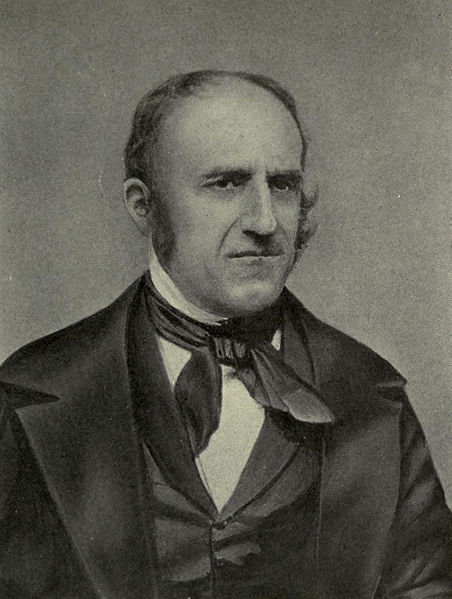
From Mark Hopkins’ The Scriptural Idea of Man.  Hopkins was a legendary teacher (he taught at Williams in the middle of the 19th century).  Bliss Perry, in his winsome book, And Gladly Teach, talks of Hopkins’ power as a teacher.

No one can furnish an adequate definition of greatness, but Mark Hopkins, like Gladstone and Bismark, gave the beholder the instant impression of being in the presence of a great man.  He had already become in his lifetime a legend, a symbol of teaching power:  ‘Mark Hopkins on one end of a log, and a student on the other.’  [This line originated in a comment of James Garfield’s (one of Hopkins’ students):  ‘A pine bench with Mark Hopkins at one end of it and me at the other is a good enough college for me.’–KDJ]

[His students] all agree that he was not, in the strict academic sense, a ‘scholar’; the source of his power was not in his knowledge of books.  But that is an old story in the history of the world:  ‘He taught them as one having authority, and not as the scribes.’  Any teacher can study books, but books do not necessarily bring wisdom, nor that human insight essential to consummate teaching skill…

To some men in class, no doubt, he seemed a philosopher without a system, a moralist indifferent to definitions. He was in truth a builder of character who could lay a stone wall without ever looking at a blue-print.

All of us recognized his immense latent power.  ‘Half his strength he put not forth.’ Yet this apparently indolent wrestler with ideas–never dogmatic, never over-earnest, never seeming to desire converts to any creed or platform–was ceaselessly active in studying the members of each class and in directing, however subtly, the questions by which he sought to develop and test their individual capacity…