We, too, dull our understandings with trifles, fill the heavenly spaces with phantoms, waste the heavenly time with hurry. When I trouble myself over a trifle, even a trifle confessed–the loss of some little article, say–spurring my memory, and hunting the house, not from an immediate need, but from dislike of loss; when a book has been borrowed of me and not returned, and I have forgotten the borrower, and fret over the missing volume…is it not time I lost a few things when I care for them so unreasonably? This losing of things is of the mercy of God: it comes to teach us to let them go. Or have I forgotten a thought that came to me, which seemed of the truth?…I keep trying and trying to call it back, feeling a poor man till that thought be recovered–to be far more lost, perhaps, in a notebook, into which I shall never look again to find it! I forgot that it is live things which God cares about.
Category Archives: virtue and vice
A Tart, Cathartic Line
The christian wisdom requires us to rejoice in gifts given to others not only because they are given to others but because they are withheld from us.
(I found this in an old notebook and am sure I am not its author. Anyone know who is?)
Psalm 36 (Mother Maria, trans.)
An oracle for the impious
Is the sin in the deep of his heart.
He regards himself
With an eye too flattering
To discover his guilt
And hate his transgression.
Perfidy and misdeed
He plots upon his bed,
He sets his steps
Upon an evil course,
Heedless of his sin.
The words of his mouth
Are fraud and deceit,
He can no more act
Wisely or well.
…
There, see how the wicked are fallen,
They can rise no more.
Death Sermon–with a Photo
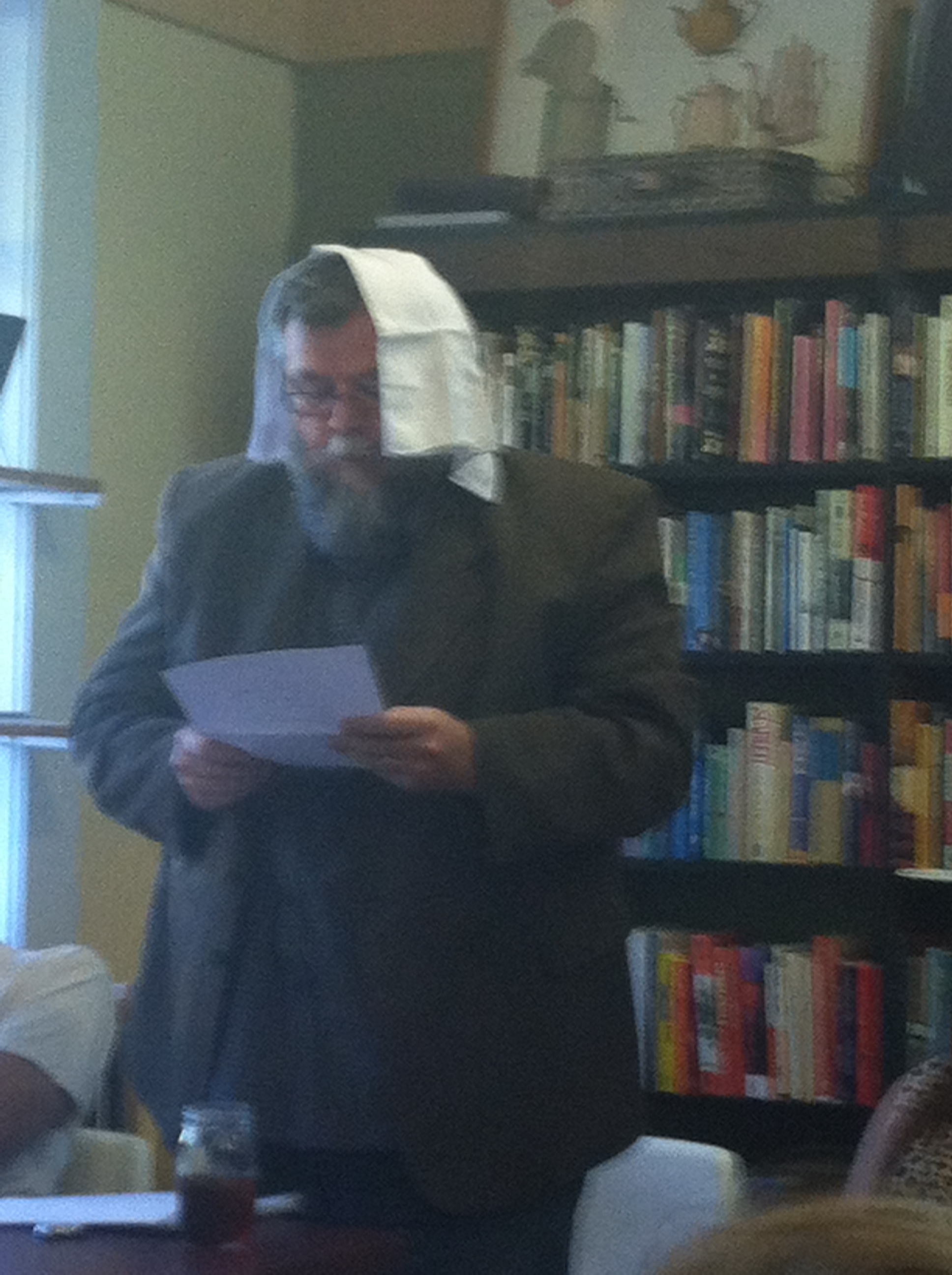
At last night’s Philosophy at the Gnu’s Room, I read these remarks and this Sermon–but I read the Sermon with my head covered.
Plato on The What and the How (but Especially the How)
…[I]t is barely possible for knowledge to be engendered of an object naturally good, in a man naturally good; but if his nature is defective, as is that of most men, for the acquisition of knowledge and the so-called virtues, and if the qualities he has have been corrupted, then not even Lynceus could make such a man see. In short, neither quickness of learning nor a good memory can make a man see when his nature is not akin to the object, for this knowledge never takes root in an alien nature; so that no man who is not naturally inclined and akin to justice and all other forms of excellence, even though he may be quick at learning and remembering this and that and other things, nor any man who though akin to justice, is slow at learning and forgetful, will ever attain the truth that is attainable about virtue. Nor about vice, either, for these must be learned together, just as the truth and error about any part of being must be learned together, through long and earnest labor…Only when all of these [instruments]–names, definitions, and visual and other perception–have been rubbed against one another and tested, pupil and teacher asking and answering questions in good will and without envy–only then, when reason and knowledge are at the very extremity of human effort, can the illuminate the nature of any object. (Seventh Letter, 334a-b)
Vanity

Self-Reliance Video, with Emerson Plug
Immortal Openings, 10: Gertrude Stein, The Making of Americans
Once an angry man dragged his father along the ground through his own orchard. “Stop!” cried the groaning old man at last, “Stop! I did not drag my father beyond this tree.”
It is hard living down the tempers we are born with. We all begin well, for in our youth there is nothing we are more intolerant of than our own sins writ large in others and we fight them fiercely in ourselves; but we grow old and we see that these our sins are of all sins the really harmless ones to own, nay they give charm to any character, and so our struggle with them dies away.
Taking it Personally
(A piece of protreptic for my Seven Deadly Sins students.)
I know some of you are struggling with the Aquinas. That is to be expected; it is hard. But too many of you have, I worry, lost sight of something that can make the reading easier and more gripping–namely, many of you have lost sight of the fact that Aquinas is telling you about your life. All that he says may sound academic, in the pejorative sense, with all his complicated talk of potency, act, complements and mastery–but it is not academic: it is existential. What he is telling you about are what we might call the necessities of human action, about its general structure, and about the ways in which understanding that structure makes you better at concerted, focused and responsible action, about the understanding necessary to become a virtuoso at living itself. Since that is what he is doing, your own life plays the role of touchstone for and testifier to the claims he makes. That is, your own day-to-day living needs to be responsive, and properly responsive, to the claims he is making. You should be able to see whether he is right or wrong, on to something or whistling in the dark, by examining what he says in the light of your own living. True, what he says sounds unfamiliar, but he is talking about familiarities, about general structures that are often closer to you than you are to yourself. Paradoxically, it is the very familiarity of what he is talking about, its closeness to you, that accounts for it seeming unfamiliar and distant. You do not want, and unfortunately show no tendency to want, to suffuse your own life with reflection, to explicitate what is implicit in your days, day in and day out, day after day. But today is the day of explicitation; tomorrow may be too late. Take what he says personally, not in the sense of an affront to you, but as aimed at who and what you are and understand yourself to be. If you can’t take Aquinas personally, you may as well leave him alone.
Paget on Sloth (from The Spirit of Discipline)
Yes, let us put together in thought the traits which meet in the picture of accidie; let us think of it in its contrast with that brightness of spiritual joy which plays around some lives, and makes the nameless, winning beauty of some souls, aye, and even of some faces; and we may recognize it, perhaps, as a cloud that has sometimes lowered near our own lives; as a storm that we have seen sweeping across the sky and hiding the horizon, even though, it may be, by God’s grace only the edge of it reached to us, only a few drops fell where we were. Heaviness, gloom, coldness, sullenness, distaste and desultory sloth in work and prayer, joylessness and thanklessness, do we not know something of the threatenings, at least, of a mood in which these meet? The mood of days on which it seems as though we cannot genuinely laugh, as though we cannot get rid of a dull or acrid tone in our voice; when it seems impossible frankly to rejoice with them that do rejoice, and equally impossible to go freely out in any true, unselfish sympathy with sorrow; days when, as one has said, everything that everybody does seems inopportune and out of good taste; days when the things that are true and honest, just and pure, lovely and of good report, seem to have lost all loveliness and glow and charm of hue, and look as dismal as a flat country in the drizzling mist of an east wind; days when we might be cynical if we had a little more energy in us; when all enthusiasm and confidence of hope, all sense of a Divine impulse, flags out of our work; when the schemes which we have begun look stale and poor and unattractive as the scenery of an empty stage by daylight; days when there is nothing that we like to do; when, without anything to complain of, nothing stirs so readily in us as complaint. Oh, if we know anything at all of such a mood as this, let us be careful how we think of it, how we deal with it; for perhaps it may not be far from that sorrow of the world which, in those who willingly indulge and welcome and invite its presence, worketh death.
 Quantum Est In Rebus Inane