“You ask kindly after my work…”–Stephen Mackenna

You ask kindly after my work:  ’tis my heartscald, would God it would be my death.  ‘Tis too hard and high for me:  gin I but grind at it two hours, I get a headache like a slow furnace and reel like one that has quaffed off the winecup–I doubt I will ever finish it, tho’ most unhappily I’m so situated, on many grave counts, that I have to keep pegging on, trying until my brain frys and I long to be quietly dead.  Otherwise my life is happy here:  I seem to have given you a false impression; no grandeurs:  but space and peace and delightful meditative walking, all around my mudcot (save where the villagers pile their dreadful heaps of dead salmon tins and broken glass and leaky kettles and Daily Mails–by choice just at my shrubbery gates.)

This from a letter likely of January 1927, to Mrs. A. F. Dodds.  Mackenna was working to translate Plotinus.  If you don’t know his translation, take a look.  It is a translation that is both all wrong as translation and all right (not just alright) as Plotinus.

Revelation–M. B. Foster

How then are we to understand Revelation in its relation to thought?  Belief in Revelation is belief that ‘God has spoken’.  What does this mean?  Or rather, what is it to believe it, if to believe involves something more than assent to a factual proposition?  Just as to apprehend God’s Holiness is to repent (‘Now mine eye seeth thee.  Wherefore I abhor myself and repent in dust and ashes’); so belief in a divine Revelation seems to involve something like a repentance in the sphere of the intellect.  Certainly it cannot be meant that we, with an unbroken intellect, are somehow privileged to talk about God.  Talking about God is one of the things which the Bible hardly permits us to do.  When Zechariah says, ‘Be silent all flesh before the Lord’, this is not wholly different from Wittgenstein’s ‘Whereof one cannot speak, thereof one must be silent’.  What Wittgenstein seems not to believe is that God has spoken.  But what is it to believe this?  –Mystery and Philosophy

Stout Affirmation–Kenneth Burke (Poem)

Whomsoever there are–
Whether enemies, than which there is several,
Or friends, than which there is few–
Here me of what I am speak of,
Leaving me promulge.

A great amt. of beauties emplenish the world,
Wherein I would o’erglance upon.
There are those which you go out and exclaim:
“Why!  How brim-brim!”

I shall be concerning sank ships
Throughout the entire Endure-Myself,
And may my foes become stumbled.
But I want you should, my dear, transpire–
Always transpire, grace-full thanlike one.

You, most prettier sing-rabbit,
And by never,
And lessermost from beneath not–
Prith, give on’t.

YES!!!


Death Sermon–with a Photo

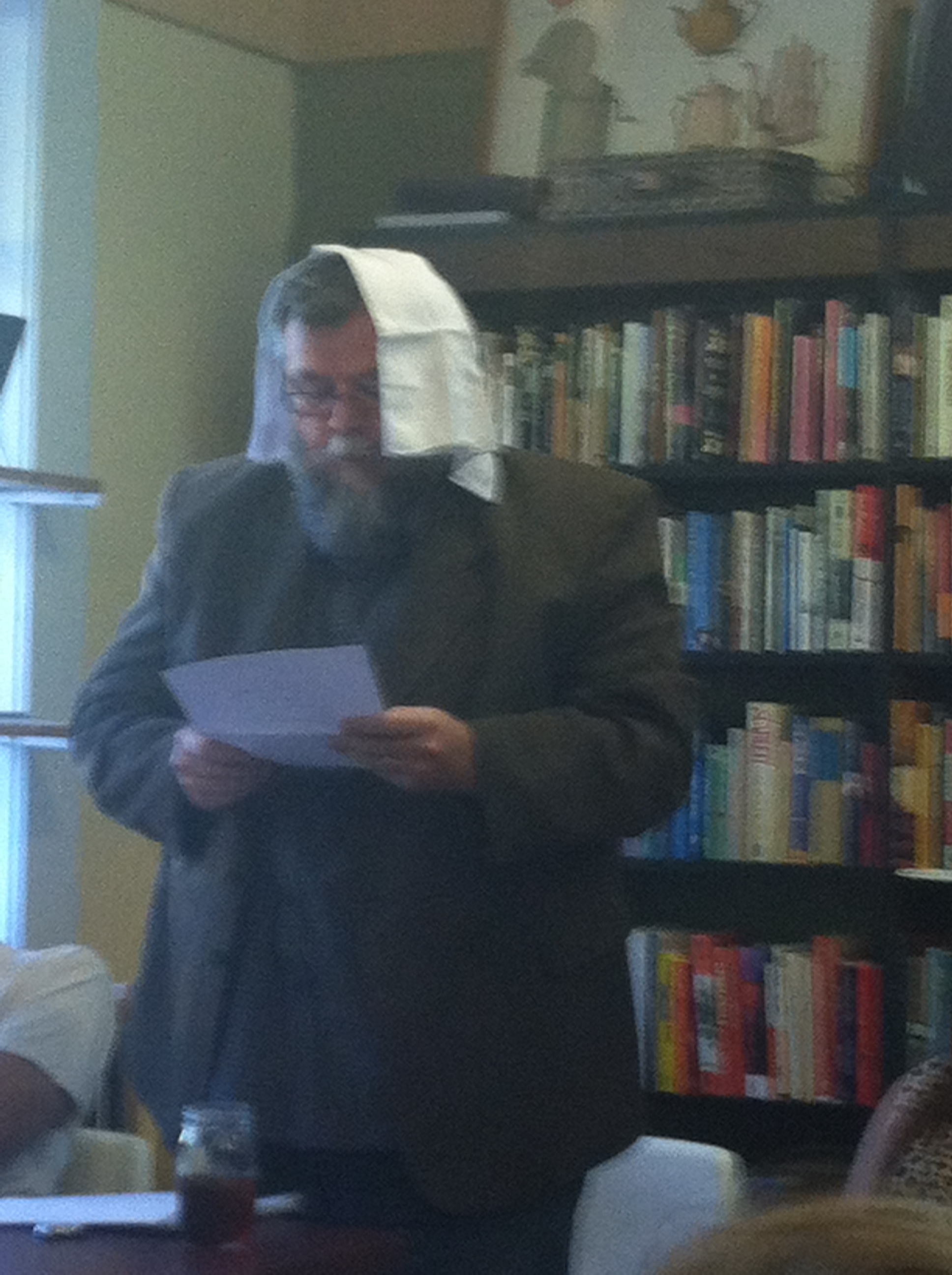
At last night’s Philosophy at the Gnu’s Room, I read these remarks and this Sermon–but I read the Sermon with my head covered.

Symparanekromenoi_speech

Wilbur–Photograph

This picture hangs near the cash register at a BBQ place I’ve frequented for years. I have always been a bit jarred by it—and frankly have typically averted my gaze from it. But today I looked at it closely (why? who knows?) and noticed it had a nameplate beneath it: “Wibur”. I wish I hadn’t looked closely.

Frege Betraying Frege

“We speak not only of the relation of a city to a country of which it is the capital or of a man to a child of which he is the father, but of the relation of an object to a function of which it is the argument.  But whereas the first relation finds expression in sentences that have in common the expression ‘capital of’ and the second have in common the expression ‘father of’, the function-argument relation finds expression in complex designations such as ‘the capital of Holland’ and ‘Rembrant’s father’, which have no expression in common.  For this relation is not one that can be put into words at all.  We might say, echoing Tractatus 4.121, that it is not something we can express by means of language, but something which expresses itself in language…

“Frege’s thesis that a concept is a particular case of a function embodies the fundamental insight that the sense in which we speak of the relation of an object to a concept it falls under is the same as that in which we speak of the relation of an object to a function of which it is an argument.  As there is no expression for the latter, so there is none for the former.  If therefore we use the locution ‘a falls under the concept F‘ and write ‘Gold falls under the concept malleable‘ in place of ‘Gold is malleable’, we do not express in words a relation that is expressed in the shorter sentence without words.  Frege thus betrays his own insight when we allows himself to be persuaded that because ‘falls under’ is a transitive verb, it stands for a relation…

“Since ‘falls under’ is not a relational expression, it follows that phrases of the form ‘the concept F‘ are not singular terms.  Unlike ‘the city of Leeds’, which designates a certain city, ‘the concept malleable‘ does not designate a certain concept.  Hence we cannot regard the verb and accusative of ‘Gold falls under the concept malleable‘ as signs in their own right.  In combination they form an expression for a concept, but in themselves are not expressions for anything.  Frege of course recognized that phrases of the form ‘the concept F’ are not concept-words, but if you take ‘falls under’ to be a genuine Beziehungswort, as Frege did in “On Concept and Object”, you have in consistency to construe such phrases as singular terms.  Frege was thus forced to equivocate:  as a singular term a phrase of this form must stand for an object, so by parity with ‘the city of Leeds’ it should stand for an object that (somehow) represents a concept.  –And yet how easy it is to go astray here!  For in our sentence there is expressed a relation between gold and the concept malleable.  So what is more natural than to assume that ‘falls under’ is an expression for that relation?  And yet the right conception is so close at hand!  For if ‘the concept malleable‘ is not an expression for a concept, it cannot stand for the second term of the relation of an object’s falling under a concept.  And so ‘falls under’ cannot itself be an expression for that relation.  We thus reach the conclusion that the relation expressed in our sentence is not expressed by it.”   (Peter Long, “Formal Relations”)

Orthodox Socrates–Fr. Yelchaninov

Socrates is Orthodox in the structure of his soul:  one of the essential traits of Orthodoxy—the hearts in “earthen vessels” (2 Cor. 4: 7) illuminated by Grace.  Precisely this attracts us in Socrates also.