I have been horrified lately at the capacity of the human voice, quite apart from what it says, simply in itself, to express the spiritual extinction of a whole people; and not merely individually, but to betray, to express and proclaim it typically, representatively. The voice of the announcer.
Theodor Haecker, Journal in the Night
Home Again
Back on the gravel road, the road I grew up on. Oppressive heat, barely beaten back by the asthmatic old air conditioner in the double-wide I grew up in. In which Mom and Dad still live. With its uneven floors, and soft spots, feeling to hesitant feet a bit like a newborn’s head does to gentle fingers. Wicker everywhere. One well placed match and there’d be conflagration. Heat hangs heavy, heavy. I watch kittens play on the furniture. Lucinda Williams sings in my head. Home again.
Travels
I am about to begin traveling, so things will be very slow here. I know they have not yet gotten back to their pre-Summer speed; I hope they will return to that speed when I return later this month. Some time away should do me good. As always, thanks to those of you who keep up with the blog and especially to those who comment. While I am away, please keep up with the blogs on my bloglist: there’s been lots worth reading on Mists on the Rivers, on Distinctly Praise the Years, on Logismoi, on Montaigbahktinian, etc.
Happy Fourth of July!
Julian Barnes on Reading
Reading is a majority skill but a minority art.
Read the whole article here.
Philosophical Questions 1
 I’ve been thinking lately about questions, philosophical questions. It seems to me–although I admit to being unable to take this thought very far yet–that one useful way of gaining insight into a philosopher’s work is by working delicately to typify the relationship between the philosopher’s questions and her answers to them. Perhaps, so stated, that seems obvious. But what I mean is typifying the relationship as such (if that can be done), independent of the particular erototetic content or declarative content of the question and answer, respectively. There are, I submit, a vast number of different typifying relationships to be discovered. Part of the reason I began to think about this was re-reading a comment of mine on G. E. Moore:
Moore insists that we often ask a philosophical question without knowing quite what question our interrogatory words express. But Moore does not ever seriously doubt that there is a philosophical question that the words express. We can rightly say that Moore doubted the clarity of the questions that philosophers asked, and we can rightly say that he often doubted whether philosophers really believed the answers they gave to the questions; but we cannot rightly say that he doubted whether there were philosophical questions to be asked and answers to be given to them. That Moore took this view of philosophical questions is shown by his deep unease with his own answers to them. Moore, I think, believed his answers; but he also did not believe his answers. (“I believe; help thou my unbelief.”) His deep unease was the result of the mismatch between his understanding of the questions and the believability of his answers to them: given his view of the questions, the very believability of his answers to them made the answers hard to believe.
Socrates’ questions and answers bear one sort of relationship to each other. Augustine’s another. Aquinas’ another. Kant’s another–and so on. Consider Heidegger, at least late: he so absolutizes the question over the answer that it is no longer clear that there is, that there could be, even that there should be any answer to the question or even an attempt at an answer. Such an attempt would violate the absoluteness of the question, allow us at least the hope of being able to end, at least for a moment, enduring the interrogative rack, to stop bearing the question mark, to finish the forever-rising inflection–to scramble off the heath and into shelter, no longer exposed as mad Lear. But Heidegger would have us stay.
(Ok, so I got a little carried away there. Apologies. But I plan to return–soberly–to this line of thought in coming days.)
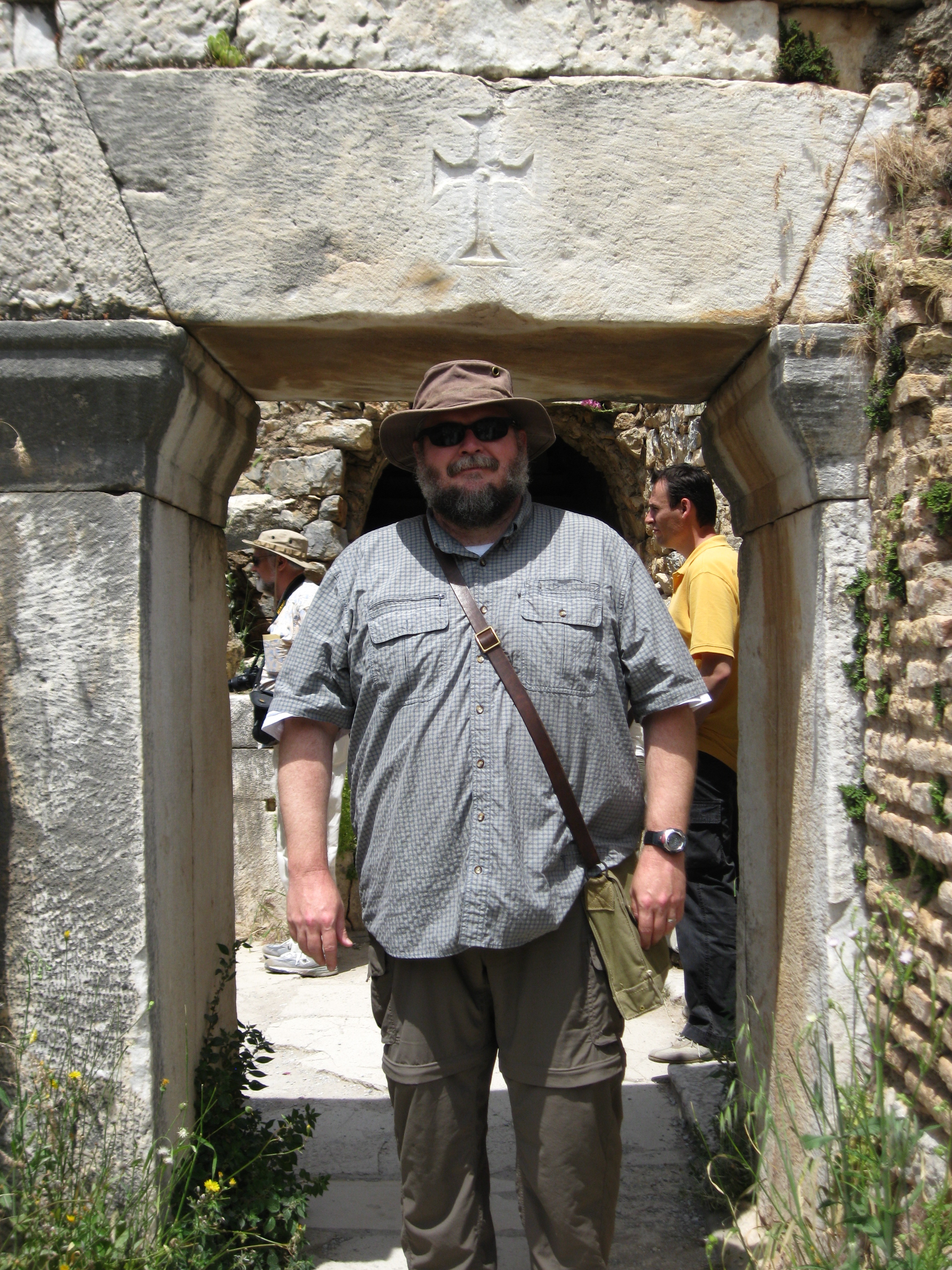
At Ephesus (Photo)
Immortal Openings, 10: Gertrude Stein, The Making of Americans
Once an angry man dragged his father along the ground through his own orchard. “Stop!” cried the groaning old man at last, “Stop! I did not drag my father beyond this tree.”
It is hard living down the tempers we are born with. We all begin well, for in our youth there is nothing we are more intolerant of than our own sins writ large in others and we fight them fiercely in ourselves; but we grow old and we see that these our sins are of all sins the really harmless ones to own, nay they give charm to any character, and so our struggle with them dies away.
Summer’s the Worst
Terrarium living has begun again in earnest in east Alabama. Here’s something dark and cool.
“Saturday” (Henry Green)

I don’t know how many are fans of Henry Green, but I thought I would share a fragment of one of his lesser-known short stories, “Saturday”. Green was “experimenting with the definite article”.
Morning.
Life was in her. Life was in her and beat there. Her bed was next theirs. Their beds took up the room. Her father and mother slept now in that bed. No blind was over window. Sun came by it. And she turned head over from sun toward them sleeping and did not see them. She smiled. Head on bolster was in sunshine.
Life was in her belly. Life beat there.
Morning. Thousands slept. Town was over miles round. Thousands of houses. In each they slept.
Under blanket hands were pressed to her belly. Her fingers stuck out round. With them she felt beating there. She smiled. Sun came in over her. She was just out of sleep, just in sleep. All of her was under sunshine, in that life beating under her fingers stuck out round.
Thousands slept. Were thousands of houses. In each they slept.
Morning.
Nauseated
It is Sarte’s birthday. I find myself conflicted.
Coming of age philosophically in a department supersaturated by the methods and work of Chisholm and Gettier was difficult for me. My sympathies were wider than that, and, even worse, I had serious reservations about the Propose-a-Definition-Cast-about-for-a-Counterexample style of philosophizing I was being taught. In those days, the president of Rochester was a philosopher, Dennis O’Brien. O’Brien had written a dissertation on Wittgenstein (under Richard McKeon, believe it or not), taught at Princeton (where he wrote a book, Hegel on Reason in History), and served as president of Bucknell before coming to Rochester. (Those familiar with the secondary literature on Wittgenstein may know O’Brien’s fine paper, “The Unity of Wittgenstein’s Thought”, one of the earliest papers challenging the Two Wittgensteins orthodoxy, and containing the exactly appropriate continuation of the famous Wittgensteinian advice, “Don’t ask for the meaning, ask for the use”–“And don’t ask for the use, either!”) At Rochester, O’Brien discomfitted the faculty by teaching courses on Sartre. The TA assignment for those courses was disrelished by graduate students: after all, the courses were on Sartre, Sartre!—and they required a lot of preparation because O’Brien’s presidential duties could any week call him away leaving the grad student with a 3-hour lecture to give on some portion of Being and Nothingness. Predictably, given the view in the department that I would read anything (not exactly a compliment), I got tabbed for the assignment. It was a lot of work, but I learnt a lot about Sartre and a lot about teaching from O’Brien. I am in his debt.
But, Sartre. Well, I never know what to say about him. There’s so much I admire and so much I don’t. Undoubtedly, the man could write–and there are many moments of profound phenomenological insight in his work. Still, there is something wrong with it. Marcel, I believe, has helpful things to say about that. In an aside in “Testimony and Existentialism”, Marcel quotes Sartre’s B & N discussion of gifts and giving, which opens with “Gift is a primitive form of destruction…Generosity is, above all, a destructive function”. Marcel responds:
I doubt if there exists a passage in Sartre’s work which is more revealing of his inability to grasp the genuine reality of what is meant by we or of what governs this reality, that is precisely the capacity to open ourselves to others.
I admit that seems right to me. I have sometimes teased students in my classes by commenting that many forms of existentialism can be produced via a formula: Choose one of the seven deadly sins. Imagine someone held fast in the grip of the vice. Now, treat that person as the norm of human existence, and the phenomenology of the vice as the phenomenology of existence per se. Of course, I am teasing when I say this, but like most professorial humor it has a point, it is meant to shed some light. In Henry Fairlie’s book, The Seven Deadly Sins Today, each chapter on a deadly sin is prefaced by a drawing by Vint Lawrence. Here’s the drawing of envy.

Isn’t this a drawing of the Sartrean human? Sideways keyhole spying, fingernail gnawing, distendly squatting, beingful of nothingness?
Of course, I could be wrong.
 Quantum Est In Rebus Inane