On a School-Teacher/Epitaph of Nearchos (Two Poems from the Greek Anthology)

Hail O ye seven pupils
Of Aristeides the Rhetorician:
4 walls
& 3 settees

Rest lightly O Earth upon this wretched Nearchos
That the dogs may have no trouble in dragging
him out.

A Few ?s on Climacus

The relationship between Climacus’ Fragments and Postscript is unsurprisingly surprising and complex.  For example, Climacus treats Part One of Postscript as the proper (promised) sequel to Fragments, while he treats Part Two as “a renewed attempt on the same lines” but not as the proper sequel.  I suppose this must be one reason why the speculative side of the objective problem (in Part One) is treated in such a brief, comparatively off-hand manner–it had really been done already in Fragments.  The historical side is what was not done there.  Right?

The argument for the ignoratio elenchi of historical inquiry into Holy Scripture (to help or hurt belief in faith) puzzles  me.  The general form of the argument is perfectly clear:  Assume that historical inquiry has culminated in a set of the happiest results any theologian could wish.  Still, that assumption does not aid the believer in faith.  Assume that historical inquiry has culminated in a set of the unhappiest results any theologian could have dreaded.  Still, that assumption does not harm the believer in faith.  The believer is untouched by either assumption since only if he were an unbelieving believer (in other words, someone who has turned Christianity into something objective) would he be bolstered by or vulnerable to these assumptions about objective results.  Conclusion:  historical inquiry into Holy Scripture is beside the point for the believer in faith; it can neither aid nor harm the believer in faith.  But here’s a question about the detail of the argument.  How far into the content of Holy Scripture do the assumptions penetrate?  The happy results supposed to be of this sort: These books and no others belong to the canon; these books are authentic; these books are complete; the authors of these books are trustworthy; these books are logically consistent.  The unhappy results are the denials of the happy results.  So–is the following among the happy results?

Jesus turned water into wine at a wedding feast.

Or is the result supposed to be like this?

A  trustworthy author wrote, in an authentic, integral, and canonical book that Jesus turned water into wine at a wedding feast.

I take this last to be such that it is not supposed to allow the detachment of ‘Jesus turned water into wine’ from it.  (The prefix is not like ‘It is true that’.)  –Maybe another way of putting my worry is to ask just about the trustworthy happy-result:  If the authors are trustworthy, does that mean that they are accurately reporting events or does it mean that they are sincerely reporting them?  The first putative happy result looks like something that would be believed in faith; the second not.  I lean toward the second.  –One other reason this is so tricky is that the first putative happy result looks like it is open to an objective/subjective ambiguity; it can be believed in faith or objectively believed (or so it seems to me).  But if that is true, why can’t the first putative happy result be an actual happy result, assuming it is objectively believed (as it would be, given that it is to be an objective result)?  Gah.  Help.  (Thanks to my students, Greg and Megan, for pushing me on this worry.)

Tampa Bound

Tomorrow, I’m on my way to Tampa for the ASA meeting.  There’ll likely be no posts, and certainly no regular posts, for the rest of the week.  If you are at the meeting, look me up!

“The Wall”–a fragment (David Jones)

We don’t know the ins and outs
how should we? how could we?
It’s not for the likes of you and me to cogitate high policy or to
guess the inscrutable economy of the pontifex
from the circuit of the agger
from the traverse of the wall.
But you see a thing or two
in our walk of life
walking the compass of the vallum
walking for twenty years of nights
round and round and back & fro
on the walls that contain the world

You see a thing or two, you think a thing or two, in our walk of
life, walking for twenty years, by day, by night, doing the rounds
on the walls that maintain the world

A Vignette on Sense-Data

To convince someone that what he really sees is sense-data, it won’t do to ply him with arguments while he is doubtful about what he sees. If he questions his own eyes, he will be in no receptive state for your gospel—your good news about a medium of unvarnished news. You can insist; he will blink and rub his eyes. He takes himself to be in a poor position to see something. You do not aid him by insisting that he is a perfect position to see something poor. He wants to move closer, to turn on a light, to visit an optometrist. You want him to listen to argument. To convince him you need him convicted by his sight. He needs to take himself to be in optimal conditions for seeing. He should stare and not blink; rub his head and not his eyes. He should not doubt his eyes; he should doubt sans phrase. He should not feel compelled to move closer, to turn on a light or to visit an optometrist. He should listen to your argument while staring fixedly at whatever he takes himself to see. Sense-data only show themselves to doubt sans phrase. Seeing them requires vision mixed with argument. They hide themselves from someone who simply doubts his eyes.

Muddy Waters–Poem

Muddy waters hide creatures beneath.  We know this because
Turtles spy on us from nearby, black heads breaking the surface.

Each of us, book in hand, sits and reads.  We were here last night
When a knot of toads and an army of frogs barked at us, each other.
Bats frantic twilight butterflies.

I think of Modern Love, egoist that I am.  I drink the pale drug of
Silence, a junky.  Forty-one and tongue-tied I have words only
Of quotation.  Thoreau.  Nature exhibits herself to us by turns and
The ice in your pint jar of water falls forward in a clump
Against your lip as you drink.

No one disturbs us here, although I did hear voices—over there,
By the waterfall.  I circle words on the page.  ‘Mystics’, ‘depths’,
‘Under’.  I etch marginalia:  “The holiness of what ought to be?”

Warm in the sun I shut the book.  Walk?  Yes.  We walk in Love’s
Deep Woods.  I would talk, but the weight of my bag, with our books,
And the warmth of the air, shorten my breath.

From where this long silence, this big quiet?  Who set this watch
On my lips?  Will no angel roll back the stone?  What seek the speaking
With the dead?  The tongue no man can tame time has.

We were here last night.  We are here today.  We are walking, now
Past the waterfall and the knee-high longleaf pines.  Trees that have
Evolved fire proof.   The Barn Trace our path and we end among stones
Once a walkway.  The house is gone but the barn stands.  Silence
Is broken by passing cars.  We are out of the woods.

Unbelieving Believers: The Intended Audience of Concluding Unscientific Postscript

Keeping his intended audience in mind is perhaps the most difficult thing to do when reading Johannes Climacus’ Postscript.  He writes, neither to those who deliberately reject Christianity nor to genuinely faithful Christians.  He is not writing to those who are caught in the throes of becoming a Christian.  Each of these audiences can of course find much in Postscript, but it is not written to them.  And, far too often, Postscript is criticized as if it had been written to these audiences.  (As a result, the book is criticized as if it were apologetics (God forbid!) or as if it were evangelistic).

Now I realize this may seem a strange claim, especially in the case of the last group, those in the throes of becoming a Christian.  “After all,” an objector might say, “Climacus’ controlling question is:  ‘How do I become a Christian?’  So isn’t he writing to that group?”

No.  Climacus’ interest in his controlling question is retrospective, not prospective.  He asks the question, and answers it, not as an exercise in evangelism, not as a tractarian, but for the sake of his intended audience, those who believe that they are believers, but who fail to believe.  His interest in his question is retrospective because, given the confusions of his intended audience, they will think of themselves as on the far end, as it were, of the question, not on its near end.  They need to realize that the way in which they believe they became believers is not a way of becoming believers.  I will call the intended audience the unbelieving believers.*

This intended audience is not wholly homogenous.  Some of the unbelieving believers account for their becoming Christians by believing it as a historical truth; some account for their becoming Christians by believing it as a speculative truth.  But both sub-groups have treated becoming a Christian as coming to be objectively convinced of the truth of Christianity.  To the extent that they have been worried about their subjective relationship to Christianity, their appropriation of it, they have taken it to be precipitated from objective conviction.  But appropriation does not precipitate from objective conviction.  Even worse, objective conviction makes appropriation even more difficult than it already is.  Objective conviction requires the inquirer to discipline out of her inquiry all questions of subjectivity, of how she is related to the object.  That very disciplining out tends to attenuate or destroy subjectivity.—This is one reason why the unbelieving believer who worries about appropriation expects appropriation to precipitate from objective conviction–the conditions of acquiring objective conviction are hostile to appropriation, so if it is to happen, it will look to those who pursue objective conviction but worry about appropriation like something that really can happen only once objective conviction occurs.

In showing what is really involved in becoming a Christian Climacus aims to shock his audience into recognizing that they are unbelieving believers.  Their account of how they became Christians, once they are clear about it and about the way one does actually become a Christian, reveals that they are not Christians.  They may be objectively convinced of something–it is unclear it really counts as Christianity–but they are not really believers, appropriators of Christianity.

That unbelieving believers are the intended audience is part of the story why Climacus is not much concerned about answering the objective question about the truth of Christianity.  (It is not the full story, but I am unsure I can tell the full story.)  His intended audience takes that question as settled.  They expect settling it to have settled the question of their faith too.  Climacus aims at unsettlement.  He will begin with an invitation:  “Tell me, and tell yourself, how you became a Christian…”

*NB  I use this phrase to suggest the simultaneous similarity and dissimilarity between Climacus’ intended audience and the father of the son possessed by a spirit (in Mark 9; cf. especially 9:24).
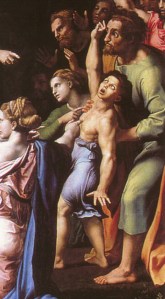

More On Emerson’s Incarnational Method

I intend to get to Emerson on Montaigne, really to get to it, soon.  But I find myself wanting, needing I guess, to say more about what I turbidly called “Emerson’s Incarnational Method“.  I was drawn to that phrase because it seemed, and still seems to me to educe something deeply important in Emerson, something both inspiring and difficult.  I addressed the inspiring last time.  I want now to address the difficult.  I do so with hesitancy, for reasons that should be apparent momentarily.

A common complaint about Emerson is that he lacks a sense of tragedy.  There is something to that.  Recall the awful scene of Emerson having Waldo exhumed, so that he can see that Waldo is dead, that Waldo’s dust is returning to dust.  Emerson wants to think and write Incarnationally; he wants to live that way.  But he cannot manage it resolutely.  (Can anyone?)  When writing to read in public, he tends always to see the relationship of fact to morals, to see the heavens in the earthly world.  And this makes him, and his urging his readers toward self-reliance and self-obedience, too Docetist.  He has a hard time with the hard facts, with the facts in relation to sensation. He writes from a luminous sense of omniscence, of omnipotence:  everything is transfigured, aglow with uncreated light.  But in his writing for himself, in his living, he finds that he is a dwarf, omni-nescient, powerless.  He is too Ebionite.  His son is taken from him in the sixth year of his joy, but Emerson cannot accept that.  Death, in particular the death of Waldo, seems like the triumph of sensation over morals, a putting-out of the uncreated light, darkness.  As he puts it in a journal entry (the one I am weaving into this post), he knows himself defeated constantly, but believes he is “born to victory”.

It strikes me that Emerson lacks a true sense of the sacramental.  (I believe this shows itself in Emerson’s (mis)understanding of religious ritual.)  For Emerson, creation itself is and should be sacramental, and the Incarnation he is and strives better to be is itself an instance of the sacramental, and is oriented toward the fullness of the sacramental.  The Incarnation finishes the sacramental activity of creation. Emerson needs to see the material as itself what realizes the spiritual, the tangible as what itself what realizes the moral.  But he all-too-often sees the material as opposed to the spiritual, the tangible as opposed to the moral.  So seeing, he all-too-often confronts facts divided, divided into the side that is related to sensation and the side that is related to morals.  So seeing, he becomes overwhelmed with the material, with sensation, and cannot find his way out of the darkness.  He would have Waldo immortal; he cannot imagine Waldo resurrected:  he is left with Waldo dead.  –How can someone born to victory be so defeated?

William Temple on the Frege Channel

Because Psychology studies mental processes, it is very liable to behave as if Logic…were one of its subdivisions.  But in fact Psychology, like every other science, must presuppose the autonomy of Logic; otherwise the writings of psychologists could be no more than their own autobiographies–not nearly so interesting or important as the autobiographies of statesmen, soldiers or artists.  The interest which a psychologist claims for his theory is not that he happens to hold it, but that it is a true account of your experience and mine as well as of his own.  But in this case he must have something to say in support of his theory over and above its psychological history.  For every theory ever held has a psychological history.