Reading “RM” 8: Skepticism

In Bk III, Montaigne’s skepticism is not something he has, an acquisition; it is something that he is, a state of being.  Call it, if you will, a nisus (in F. R. Leavis’ sense of that term), a profound, unwilled set of Montaigne’s whole being.  Unwilled:  for there is no striving in it, no stretching, in particular no self-assertion or desire to exalt himself; it is ripe with a joyful tranquility.  It is a nisus toward the total truth.  But there is no hurry, no hurry; hurry would slow him down.  He fondly and patiently contemplates himself and his life and life.  Each essay is a new elucidation of our human being.  He writes out of a prodigious lucidity, exhibiting himself to himself (and so exhibiting us to ourselves) across a living width of aspects.

He writes under the sign of Socrates.  Socrates’ labor (think of the Oracle and of his understanding of it) is to dismantle double ignorance:  the state of those who think they know but do not know.  Simple ignorance, simply not knowing, typically need not be considered vicious.  Its remedy is most often obvious and requires only time and application.  Double ignorance is vicious; in it, simple ignorance teams with pride.  Socrates attacks double ignorance and scorns the consequences of attacking it, drawing wisdom and courage from unknown deeps in himself.   His highest hope is to attain to a genuinely humble mind–where the humility is simultaneously and wholly epistemological and moral.  He hopes this for his interlocutor as well.  Thomas De Quincy writes,

Without hands a man might have feet and could still walk:  but, consider it, –without morality, intellect were impossible for him; a thoroughly immoral man could not know a thing at all!  To know a thing, what we can call knowlng, a man must first love the thing, sympathize with it:  that is, be virtuously related to it.  If he have not the justice to put down his own selfishness at every turn, the courage to stand by the dangerous-true at every turn, how shall he know?  His virtues, all of them, will lie recorded in his knowledge.

Socrates’ elenchus targets unacknowledged ignorance; to accept aporia is to be humbled both epistemologically and morally.  Is accepting aporia enough to qualify as a skeptic?  Well, say what you will.  I deem there is no reason to refuse that title to someone who accepts aporia.  Notice that, like everything else, accepting aporia has its conditions.  Crucially, someone who accepts aporia recognizes that he has bottomed out, bottomed out in knowledge, bottomed out in pride, and is now ready to go on.   Aporia ends nothing, except perhaps an episode of conversation; in reality, it is a beginning.  Its valence is positive, not negative; the sun is rising, not setting.  Aporia marks the moment when we come to see that what we are contending with is a mystery, not a problem.   —If this be skepticism, what more can be said about it?  It is a skepticism that is turned against worldly wisdom, not a skepticism that is a form of worldly wisdom.  By the standards of worldly wisdom, Euthyphro knows and is rightly proud of what he knows.  By the standards of worldly wisdom, Callicles knows and is rightly proud of what he knows.  Socrates will not judge or be judged by those standards.

Montaigne’s Bk III essays are skeptical in this way, this Socratic way.  To read the essays is to become Montaigne’s interlocutor.  The essays are designed to create aporia in the reader, and to bring about its acceptance.  To almost quote John Berryman:

Wif an essay of Montaigne’s in either hand
We are stript down to move on

Reading “RM” 7: Consciousness

Merleau-Ponty engages one of the most difficult ideas of the essay very near its beginning.  He writes of Montaigne:

Self-consciousness is his constant, the measure of all doctrines for him.  It could be said that he never got over a certain wonder at himself which constitutes the whole substance of his works and wisdom.  He never tired of experiencing the paradox of a conscious being.

Having written that, he turns directly to the task of differentiating Montaigne’s understanding of conscious being from Descartes’.  Montaigne’s understanding is as follows:

At each instant, in love, in political life, in perception’s silent life, we adhere to something, make it our own, and yet withdraw from it and hold it at a distance, without which we would know nothing about it.

Merleau-Ponty terms this adherence and withdrawal, consciousness’ acceptance and alienation, consciousness’ bondage and freedom, “…one sole ambiguous act…”  Descartes understands conscious being differently.  For him, consciousness is not one sole ambiguous act, but rather a pure act:  it does not adhere, accept or become bound.  It is all withdrawal, alienation and freedom.

Montaigne does not know that resting place, that self-possession, which Cartesian understanding is to be.  The world is not for him a system of objects the idea of which he has in his possession; the self is not for him the purity of an intellectual consciousness.

Later in the essay, Merleau-Ponty again contrasts Montaigne and Descartes:

Descartes will briefly confirm the soul and body’s union, and prefer to think them separate; for then they are clear to understanding.  Montaigne’s realm, on the contrary, is the “mixture” of soul and body’; he is interested only in our factual condition, and his book endlessly describes this paradoxical fact that we are.

I take all of this differentiating to be internal to understanding Montaigne’s skepticism.  But before I say anything more about that, and I will by and by, I want to say a little about the differentiating itself.  What exactly is Merleau-Ponty describing, what sort of distinction is he drawing? The answer seems to me to be in the phrase “…one sole ambiguous act…”  For Montaigne, as Merleau-Ponty reads him, to be conscious of something, say of a horse seen through the library window, is to be open to the world, to the horse, even adherent to the horse; the horse is a gift that we accept.  There is no question that what we are conscious of is the horse.  And, being conscious of the horse, there is a sense in which consciousness becomes the horse, incarnates itself in horseflesh.  Yet, in the same act, consciousness withdraws into a kind of distance from the horse, alienates itself from the horse, is free of horseflesh, is utterly discarnate.  But this is not to be decried:  without the distance, the alienation, the freedom, we could not know the horse. “We are equally incapable of dwelling in ourselves and in things, and we are referred from them to ourselves and back again.”  Although Merleau-Ponty puts this in a way that sounds as though it is successive acts, I take him to be describing one sole ambiguous act, and act in which we are all at once all in and all out.   This is the paradox of conscious being.  We are everything and nothing.  We are Gods in nature; we are weeds by the wall.  We are not these by turns, but simultaneously, our conscious being is at each moment one sole ambiguous act.  Montaigne never got over a certain wonder at this, and no wonder.  Montaigne’s consciousness is in one sole ambiguous act a becoming and a knowing; and each requires the other while also being capable (abstractly) of cancelling the other:  to simply become would be to fail to know; to simply know would be to fail to become.  By becoming, we are in a world; by knowing, we find ourselves in that world.  But strangely, again paradoxically, our finding ourselves in the world requires that we not be where we are in the world.  “To be conscious is, among other things, to be somewhere else.”  Somewhere else, of course, contrasts with here, i.e with where I am.

For Descartes, consciousness dwells in itself; consciousness is a resting place.  It possesses itself–but that is all it possesses, since its ideas are crucially creatures of itself.  It is not tied to things, adherent to them.  It remains pure, wholly self-involved.  (This understanding of conscious being is in part responsible for Cartesianism being a gap-displaying method.)  The world of Cartesian consciousness is a system of objects kept by God in the right sort of relation to its ideas.  Cartesian consciousness is all light within; all darkness without.  The Cartesian walks by reason and not by sight.  He has the key to the world.  Montaigne (like Pascal, according to Merleau-Ponty) understands himself as interested in a world he does not have the key to.  For Montaigne, the world is a motley of things of things making an appeal to consciousness, and consciousness in response turns outside while it also faces inside.  The lightness and darkness of Montaigne’s consciousness is a crazy plaid, thrown over inside and outside alike.  Opacity is as much an inside thing as an outside thing.

As a result, achieving self-understanding cannot be circumspectly rotating the oculus mentis around its clean and well-lit place.  It is rather self-questioning, a dialogue with self in which the being who answers is at least partly opaque to the being who asks, and the being who questions must wait for an answer, “…a questioning without which reason’s purity would be illusory and in the end impure…”  Purifying reason requires self-questioning, not merely “visual” self-inspection.  It happens over time, not all at once, and it never results in any final purity, but must be done again and again, day after day, as Socrates did it in the Agora, and once, outside Athens’ walls, under a tree with Phaedrus.  “Phaedrus, my friend!  Where have you been?  And where are you going?”

Reading “Reading Montaigne” 3: Quotable Unquotability and Metonymic Quotation

(I just realized that I wrote this several days ago but forgot to post it.  Sorry it is out of order, but I left its number in its name, so that it can be placed.)

Final Preliminary:

I have mentioned Montaigne’s quotable unquotability.  I have mentioned that it makes writing on Montaigne difficult.  So what is to be done about it?  Am I setting up for a criticism of Merleau-Ponty’s quotation of Montaigne in “RM”?  No.  I am setting up for a practice of quotation that I want to continue and that I reckon Merleau-Ponty to use.  As I have mentioned, Merleau-Ponty quotes only from Bk III of the Essays; I am going to do the same.  Merleau-Ponty’s Montaigne is the Montaigne of Bk III.  I take Merleau-Ponty to be practicing what I will call “metonymic quotation”.  That is, he quotes Montaigne intending for the quotation to be a part that trails the whole, where the whole is first the essay from which the quotation is taken and second Bk III itself.  This means that Merleau-Ponty writes and quotes really only for those who are capable of appreciating the metonymic quotations, those who know the particular essay and who know Bk III.  I intend to do the same.  But I will, at least in places, reduce the metonymic strain and supply more of the relevant section of the essay quoted than Merleau-Ponty does.  When an author is quotably unquotable, metonymic quotation is the best strategy for avoiding what I will call “sententious quotation”, a practice of quotation that makes it look like single sentences carry the burden of a moral, a meaning, in particular a moral or meaning that is capable of isolated appreciation, that carries, as it were, its entire moral burden or burden of meaning between its initial capital and its period.  Metonymic translation sees what is quoted as, in a sense borrowed from Gottlob Frege, unsaturated, as needing completion–not exactly in the way of a Fregean concept, nor exactly in the way of a Fregean truth-functional operator (say, negation), but in a way related to them.  In other words, the quoted sentence is to be understood as abstracted, in specific way, from its context, not extracted from it.

Reading “RM” 6: Problems vs. Mysteries

For some of us, the impulse to philosophize is bound up with a realization of our broken world and our patchwork lives.  But among those of us for whom this is true, there is a further division:  for some of us, the breaks and the patchworks are problems, something to be solved; for others of us, they are mysteries, something that we live through.  Marcel famously distinguishes problems from mysteries; I am using his distinction—but I will not try here to provide a full account of the distinction, rather only an anticipatory sketch.  I need the sketch because it will aid me in my continuing reading of Merleau-Ponty’s “RM”.  I will say a bit about how momentarily.

Central to Marcel’s distinction is this:  a mystery is something whose true nature can only be grasped from the inside; no objective statements can be made about it from outside, for it is our situation, ours to live through.  We cannot get outside of it.  A problem has no inside/outside contrast, so to speak; it is something I confront, something I find complete before me.  I can therefore, as Marcel puts it, “lay siege to it”.  A problem is an object before me, inert; it is “voiceless”.  I can take an interest in it or not, but whether I do or not is a matter for my unconstrained decision.  A mystery is something that presents itself to me; it “speaks”; I respond or I refuse to respond.  A problem is always coordinate with a technique, a way of handling, treating, working on or solving it.  A mystery transcends technique.  Progress, as a notion, belongs to the problematic; is has no truck with the mysterious.  We make progress on a problem as we come to know things of which we previously were ignorant.  But the knowledge/ignorance contrast gets no real hold on a mystery; to the extent that it may seem to, each new acquist of relevant knowledge only to deepens the mystery.

One important result of this distinction is that it makes available a new term of philosophical criticism, namely the degrading of mysteries into problems.  We might think of this as a form of metaphilosophical reductionism.  Degrading is perennially tempting, because it allows us to normalize philosophy, to tame it.  Often, we degrade without realizing it:  we take something to have the form of a mystery while we deny it the power thereof.  Degrading permits us to be philosophers by acquisition, by having a philosophy (if you know the passage, think here of Marcel’s joking talk of “Marcelism” early in vol. 1 of The Mystery of Being), instead of requiring us to be philosophers only by maintaining ourselves in relation to mystery (since you will know it, if you have been following the blog, think here of Merleau-Ponty’s distinction between teaching the absolute and teaching our absolute relation to it.)

I know that all this is far from clear, but I will continue to develop the distinction in later posts.  For now, bear in mind that what we think of Montaigne the skeptic will be quite different if we take Montaigne to be so-called because of his response to problems or because of his response to mysteries.

Reading “RM” 5: More on Skepticism

Merleau-Ponty starts “RM” with a pertinent reminder:

Skepticism has two sides.  It means that nothing is true, but also that nothing is false.  It rejects all opinions and all behavior as absurd, but it thereby deprives us of the means of rejecting any one as false.  Destroying dogmatic, partial, or abstract truth, it insinuates the idea of a total truth with all the necessary facets and mediations.  If it multiplies contrasts and contradictions, it is because truth demands it.

The reminder here is that there is a form of skepticism, Montaigne’s, that serves the demand of truth.  As such, Montaigne’s skepticism is two-sided:  it has its expected negative side (“nothing is true”) but also its unexpected positive side (“nothing is false”).  The point of the two sides is not skeptical self-stifling, but rather an all-the-more gladsome servitude to truth.  Dogmatism, partiality, abstraction all ill-serve the truth, providing only one facet among many or excluding required mediations.  Think of this as skepticism with a finally positive valence, a skepticism that approaches truth by various refusals of truths.

As I mentioned before, in his “In Praise of Philosophy”, Merleau-Ponty insists that great philosophers thematize ambiguity, but that their so doing “contributes to establishing certitudes rather than menacing them”, and so he distinguishes between good and bad ambiguity–the one, I take it, establishing, the other menacing, certitude.  What Merleau-Ponty says about Montaigne’s skepticism concretizes the claim about thematizing ambiguity.  In destroying dogmatic, partial or abstract truth, Montaigne thematizes good ambiguity, an ambiguity calling for nuance, mediation; an ambiguity indicating the shape of the total truth.

Montaigne contradicts himself, when he does, out of the extremity of his servitude to the truth.

The first and most fundamental of contradictions is that by which the refusal of each truth uncovers a new kind of truth.

This sentence is the nervus probandi of the Merleau-Ponty’s introduction to “RM”.  Notice that Merleau-Ponty here describes (materially) metalinguistic negation.  (Laurence Horn, who has done the most to clarify this form of negation, understands it as a metalinguistic device for registering objection to a previous utterance on any grounds whatever (including even the way it was pronounced).  In the thanks-footnote to his classic article from 1985, Horn provides a gracious and humorous example of the phenomenon:  after mentioning the folks he is indebted to, he notes, “Their contributions were not important–they were invaluable.”)  I understand Merleau-Ponty to see Montaigne’s negations as informed by a recognition that a particular utterance is dogmatic, or is partial or is abstract.  That utterance is then negated on the grounds that it is either dogmatic, or…   This is the way in which Montaigne’s refusals of truths “uncover a new kind of truth”, where “new kind” does not mean that we have, as it were, shifted from a truth-predicate at say, the zero level, to one at the first level (and so on) but rather that we are moving from a partial truth to a less partial truth–and the partial truth is not negated in the sense that it is false, but rather in that it is partial.  This shifting can be seen not only at the level of particular lines of Montaigne’s essays, but even in the essay’s basic structure, in the way paragraph follows paragraph, shifting from the partiality of the previous paragraph to a subsequent paragraph that renders what is being said less partial.  The earlier paragraph is not to be refused totally, but rather refused in the interests of the total truth.  A formalist example:  If I say “It is not exactly incorrect to say that p”, I do not mean that It is correct to say that p but I also do not mean It is correct to say not-p.  Rather, saying “p” stands in need of further saying, of a further less partial saying, perhaps; or, of one less dogmatic or less abstract.  A new kind of truth is a less dogmatic or a less partial or a less abstract truth.  (Some of you will recognize metalinguistic negation from its very common use in J. L. Austin’s work, where it informs not only the content of his presentation of, e.g., performatives, but where it informs the very style of Austin’s prose.  Jean-Philippe Narboux has recently written a wonderful paper on this and related matters, “There’s Many a Slip between Cup and Lip:  Dimension and Negation in Austin”.)  Often, then, what take the form of contradictions in Montaigne are best understood as pairings of p and not*-p, its metalinguistic negation.  This has an important shaping effect on Montaigne’s skepticism and his prose, and helps to reveal that it is, as Merleau-Ponty says, two-sided, insisting on facets and mediation, multiplying contrasts and contradiction, welcoming ambiguity as a helpmeet—because truth demands it.

Reading “RM” 4: Starting on Skepticism, Cartesian and Pyrrhonian

Montaigne’s Book III essays are crossroads of skepticisms.  As a way taking up Merleau-Ponty’s take on Montaigne’s skepticism, I want to say a little about the skepticisms that I do not find as such in Montaigne.

Cartesian Skepticism.  I certainly do not mean by this that there are no moments of epistemological skepticism in Montaigne.  There are.  But they are not Cartesian, as I understand Cartesian skepticism.  Cartesian skepticism incorporates a method, first and paradigmatically exampled in the Meditations. The crucial phenomenological feature  of Cartesianism—namely the gap it finds between itself and the world—is the residue of the method.  I do not mean that the gap is methogenic, in Marvin Farber’s term, i.e., an artificial and properly discountable effect of the method itself, one overcome not by solving it within the confines of the method, but enlarging the conception of method, so that the feature vanishes, much like certain optical illusions do when we allow ourselves to get up and walk around the source of the illusion, instead of staring fixedly at it. No, I am not claiming that the Cartesian’s gap is methogenic. But I do want the connection between the method and the gap to be clear:  the Cartesian method is a gap-displaying method.  But in Montaigne, even in his moments of epistemological skepticism, no gap yawns. And, even more clearly, there is little if any method of any Cartesian sort in Montaigne’s moments of epistemological skepticism.  We need to understand such moments; but treating them as speciations of Cartesian skepticism will not help us.

Pyrrhonian skepticism.  Montaigne favors epistemic modesty but he is not advocating epistemic chastity, an epistemic policy of withholding of assent (whether it is withheld generally or only in the face of a particular class of propositions). One reason why disentangling Montaigne from Pyrrho is tricky is that Montaigne’s skepticism permeates him, permeates what he takes to be an artful, and so happy, life.  Call this the existential demand of Montaigne’s skepticism.  Pyrrhonism makes its own existential demand.  (Cartesian skepticism makes no existential demand. In fact, in the argumentative economy of the Meditations Cartesian skepticism not only makes no existential demand, but it is crucial that its making an existential demand is not fully intelligible.)  The state that the Pyrrhonian seeks to cultivate, call it a state liberated from the coils of dogmatism, differs from the one that Montaigne seeks to cultivate, although he is no fan of dogmatism.  I will investigate that difference when I turn to characterizing Montaigne’s skepticism positively.

Reading “Reading Montaigne” 2

A few more preliminary matters.

I had the good fortune, a few weeks ago while in Bordeaux, to visit Montaigne’s Chateau.  I have venerated the man and his work for many years.  That I visited while taking part in a small conference devoted to Thompson Clarke’s “The Legacy of Skepticism”, and so a conference devoted more broadly to the problem of skepticism, made the visit reverberate existentially even more than it would have.  I guess you could say I was vulnerable to the call of Montaigne in a way I was unprepared for, even though I was excited to go and expected the visit to be meaningful.

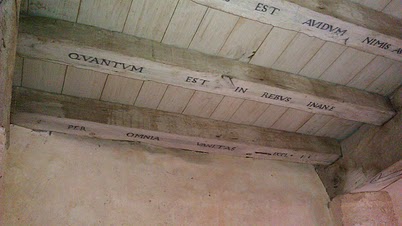
At one point I stood in Montaigne’s library, described by him in considerable detail late in “The Kinds of Association”.  The library’s ceiling was openly crosshatched by large, rough beams, into which Montaigne had carved his favorite sayings in Greek and Latin.  The first beam in the central section of the ceiling bore, “Per omnia vanitas”, the second, “Quantum est in rebus inane” (the title of this blog).  I hardly exaggerate when I say that this blog began in Montaigne’s library, as I stood beneath those beams to take a photograph.  Various seeds of ideas I have carried a long time, many planted long ago by my teacher, Lewis White Beck, during countless mornings over coffee, watered by Thompson Clarke and the conference, were given the increase by Montaigne and his library.  I am still—obviously—working to find a way to say something about what began growing that day and am still jealously guarding its continued growth.  It is always dangerous to speak, to write, too early:  but sometimes speaking, writing, is itself necessary to find your way to what you have in you to say.  (Don’t folks talk to plants to make them grow?)

A Montaigne essay is a field of interest.  (Emerson learnt this from Montaigne.)  It is a field of interest in which he participates disinterestedly.  The field of interest has a focal object (now concrete, now abstract), and Montaigne writes out of an intent absorption in that object.  It is Montaigne’s profound interest in the focal object that makes possible his disinterestedness.  This is crucial.  So often the focal object of Montaigne’s field of interest is himself; that does not forestall disinterestedness.  Montaigne drives his essays forward by means of a sustained willingness to re-encounter his focal object; one look does not suffice, he vets first impressions.  The instinct authority of the focal object obliges his experience—but the focal object does not reveal itself fully or declare the whole of its authority at any single moment of experience.  Montaigne will suffer contradiction or the appearance of contradiction rather than to disoblige his experience.  All this makes writing about Montaigne hard.  He writes what he writes where and when (in the essay) he writes it, addressed to whatever his focal object happens to be.  Quoted outside of that essayistic location, outside of that address to the focal object, what Montaigne has written is not clearly what he has written.  Sentence after sentence seems designed for citation.  But it is unclear any can survive it.  The fish that glinted multipotently beneath the water, in rainbow extravagance, is in one sense the same fish that lies in bleak grey contortion on the wet deck.  But is it in every sense the same fish?  (Emerson will push this phenomenon of quotable unquotability even further in his own way, as will Cavell in his own, different way.)

Reading “Reading Montaigne” 1

Before turning to “Reading Montaigne”, I want to notice passages from Merleau-Ponty’s talk, “In Praise of Philosophy”.  It seems clear that Montaigne is in his mind throughout the talk, and evidence of this occurs just at its end:  Montaigne is given the final (quoted) words of the essay.  But earlier there are passages that provide undeclared portraiture of Montaigne.

The philosopher is marked by the distinguishing trait that he possesses inseparably the taste for evidence and the feeling for ambiguity.  When he limits himself to accepting ambiguity, it is called equivocation.  But among the great it becomes a theme; it contributes to establishing certitudes rather than menacing them.  Therefore it is necessary to distinguish good and bad ambiguity.  Even those who have desired to work out a completely positive philosophy have been philosophers only to the extent that, at the same time, they have refused the right to install themselves in absolute knowledge.  They taught not this knowledge, but its becoming in us, not the absolute but, at most, our absolute relation to it, as Kierkegaard said.  What makes a philosopher is the movement which leads back without ceasing from knowledge to ignorance, from ignorance to knowledge, and a kind of rest in this movement…

And:

The enigma of philosophy (and of expression) is that sometimes life is the same to oneself, to others, and to the true.  These are the moments which justify it.  The philosopher counts only on them.  He will never accept to will himself against men, nor to will men against himself, nor against the true, nor the true against them.  He wishes to be everywhere at once, at the risk of never being completely anywhere.  His opposition is not aggressive; he knows that this often announces capitulation.  But he understands the rights of others and of the outside too well to permit any infringement.  If, when he is engaged in external enterprises, the attempt is made to draw him beyond the point where his activity loses the meaning which inspired it, his rejection is all the more tranquil in that it is founded on the same motives as his acceptance.  Hence the rebellious gentleness, the pensive engagement, the intangible presence which disquiets those who are with him.  As Bergson said of Ravaisson in a tone so personal that one imagines him to be speaking of himself:  “He gave no hold…He was the kind of man who does not offer sufficient resistance for one to flatter himself that he has ever seen him give way.”

The first passage bears importantly on the discussion of Montaigne’s skepticism (and so of his knowledge and his ignorance) in “Reading Montaigne” (“RM”), so I will be thinking of it when I get to that particular, difficult juncture.  Also, and related, both passages could be said to be portraiture of Socrates as well as of Montaigne.  In fact, just a bit later in the essay, Merleau-Ponty writes “We must remember Socrates” as the copestone for the section. But Merleau-Ponty’s Socrates shadows Montaigne’s Socrates.  Remember that Socrates finally eclipses various other heroes of Montaigne (like Cato the Younger) by the time of the essays in Book III, so it will be hard to describe Montaigne as he appears in them without also to some extent describing Socrates as he appeared then to Montaigne.  (By the way, since I have conjoined Socrates and Montaigne here, I note that the second passage instructively relates to my ongoing discussion of disposibility and that I in part chose it for that reason.  Oh, and one other parenthetical item, since I have mentioned Socrates:  I recall that Pierre Hadot makes interesting use of this talk of Merleau-Ponty’s in some of his work on Socrates, for example in What is Ancient Philosophy?)  I will later notice another passage from the talk when I discuss the section on Montaigne’s religion in “RM”; what Merleau-Ponty says of Socrates’ religion elucidates what he says of Montaigne’s.

I judge “RM” to have the following structure:  Introduction, Montaigne’s skepticism, Montaigne’s religion, Montaigne’s skepticism, and a critical summation of Montaigne, weaving all the earlier discussions together.  My hope is to take up first Montaigne’s skepticism, second his religion, third his stoicism, and finally to take up the summation.

Reading “Reading Montaigne”

For a long time now I have wanted to explore Merleau-Ponty’s essay on Montaigne.  I plan to begin to do that here in the next few days.  Merleau-Ponty confines himself (at least for the purposes of quoting Montaigne) to Book III of the Essays.  These essays Donald Frame adjudges “[Montaigne’s] mellowest, his most individual, his most thoroughly human.”  I will confine myself to Book III too, as far as Montaigne goes.  I may, however, make use of more than just Merleau-Ponty’s Montaigne essay; I may sift through some other work by Merleau-Ponty.