
Japanese Christian Orthodox Icon (in the Nihonga style of the late 19th-early 20th century)
Japanese Christian Orthodox Icon (in the Nihonga style of the late 19th-early 20th century)
An oracle for the impious
Is the sin in the deep of his heart.
He regards himself
With an eye too flattering
To discover his guilt
And hate his transgression.
Perfidy and misdeed
He plots upon his bed,
He sets his steps
Upon an evil course,
Heedless of his sin.
The words of his mouth
Are fraud and deceit,
He can no more act
Wisely or well.
…
There, see how the wicked are fallen,
They can rise no more.

Just out from SVS Press. I contributed an essay.
How then are we to understand Revelation in its relation to thought? Belief in Revelation is belief that ‘God has spoken’. What does this mean? Or rather, what is it to believe it, if to believe involves something more than assent to a factual proposition? Just as to apprehend God’s Holiness is to repent (‘Now mine eye seeth thee. Wherefore I abhor myself and repent in dust and ashes’); so belief in a divine Revelation seems to involve something like a repentance in the sphere of the intellect. Certainly it cannot be meant that we, with an unbroken intellect, are somehow privileged to talk about God. Talking about God is one of the things which the Bible hardly permits us to do. When Zechariah says, ‘Be silent all flesh before the Lord’, this is not wholly different from Wittgenstein’s ‘Whereof one cannot speak, thereof one must be silent’. What Wittgenstein seems not to believe is that God has spoken. But what is it to believe this? –Mystery and Philosophy
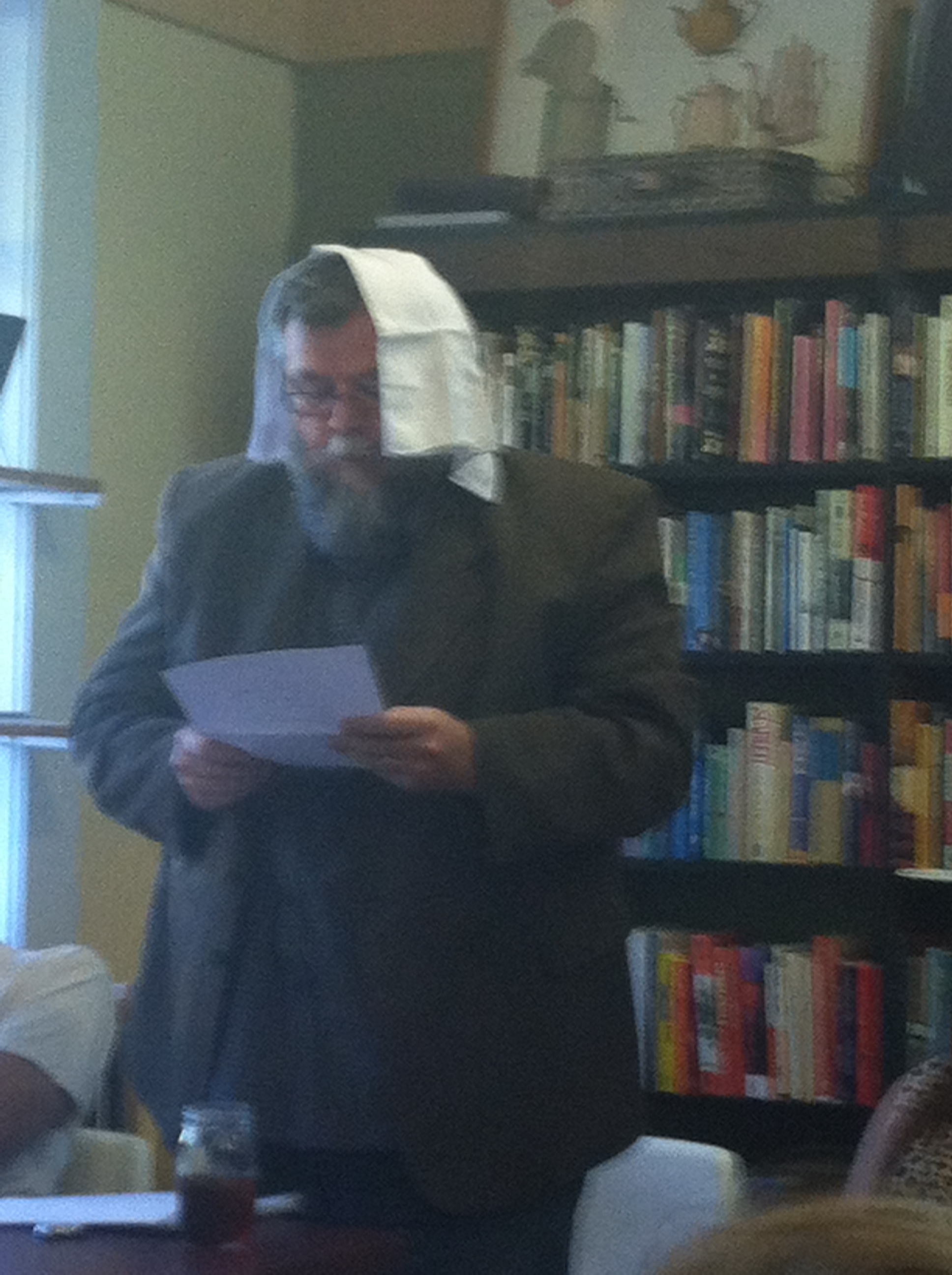
At last night’s Philosophy at the Gnu’s Room, I read these remarks and this Sermon–but I read the Sermon with my head covered.
Socrates is Orthodox in the structure of his soul: one of the essential traits of Orthodoxy—the hearts in “earthen vessels” (2 Cor. 4: 7) illuminated by Grace. Precisely this attracts us in Socrates also.
After all, Faith is not belief in spite of evidence, but life in scorn of consequence–a courageous trust in the great purpose of all things and pressing forward to finish the work which is in sight, whatever the price may be. Who knows whether the ‘personality’ of which men talk so much and know so little may not prove to be the temporary limitation rather than the necessary expression of Life?
From an old notebook:
Job’s confused. God’s not helping. God’s making it worse. So too the comforters. (Carrion comforters!) They worsen Job’s confusion. It’s not bad enough that he’s wrestling confusedly with God; his comforters want to wrestle too: against Job, for God, as if they were members of a Divine tag-team.
Job speaks out his misery. What he says is of his pain just because it expresses it. He is venting his misery more than he is accusing God. But his comforters will not hear his misery; they hear only the accusing.
Job knows what his comforters know. He knows the glory and the power of God. But he knows more than his comforters know. He knows God’s power and glory in a way that does not deny that power and glory. Even more, he knows his innocence. Job knows that God knows it too. But now it looks like Job knows too much, more anyway than he can bear, for how could a God of such power and glory and knowledge as his tolerate Job’s misery?
Hamann and the Traditon (Northwestern University Press) is just out. My essay: “Metaschematizing Socrates: Hamann, Kierkegaard and Kant on the Value of the Enlightenment” is included. The editor, Lisa Marie Anderson, did a nice job with the volume. Lots of good stuff on Hamann—including especially an essay by my friend, John Betz, who is the Hamann guy (not that that’s all he is, by any means).
(I just noticed an annoying mistake in my paper, no doubt due to my faulty proofreading. The final footnote should compare Socrates to St. John the Baptist, not to Saint Paul, as it does. )
Continuing my reading in Haecker:
Looking with a certain contempt upon Christianity, you observe that it has no philosophy, no metaphysics. But is that not an error? The Christian’s metaphysics is—that he eats God.
 Quantum Est In Rebus Inane