An oldish, but short, essay of mine on the resurrection body.
Category Archives: religion
Wondering, Where are We Going? (Mother Maria)
Christmas, 1975. Mother Maria writes a letter to a friend, musing on her own particular situation and the difficulties of getting her Monastery repaired. (That Christmas was icily cold, and Mother Maria and two others, and a cat named Nimmy, moved into the Monastery although it lacked doors and some windows.) What she says of her situation though expands to include all our situations.
We are wondering why ever more difficulties pursue us to the limit of endurance, and any new ones brace us up to a feeling that they come to destroy, and if we do not give them reality, but march through them, they cannot harm us. It is not a fairy tale that the are evil forces. Only we refuse to ‘attend’ to them, but I am crying out for help for us all; or, at least, for that which is meant to be; and that it should be achieved. Next year Chapel will live–all ready for Easter. Till April it will not be easy, but possible–till we have the whole house. It will no more be an inhuman situation. It is dark so soon, and so very dark. Not a sound. I am wondering and wondering. Where are we going?
A Little More on Church-Man’s Skepticism, and Hamlet
Reflecting on CMS last night, I was struck again by how much Hamlet is shaped by it. I suppose that is little surprise, really, since we know that Montaigne (in Florio’s translation) marked Shakespeare’s thought and language and that bits of the play rework bits of Montaigne. But it is also true–and here I do not know whether to say that Montaigne’s presence in the play is cause or effect or something else–that the Wisdom books of the Old Testament (including the sapiential Psalms) are also present throughout it. Hamlet is the Church-Man unbalanced, striving for some way of grasping per omnia vanitas without losing his grip on all that matters, and all that matters to him: CMS melds with madness. Hamlet strips Montaigne of the ironic strength of Socrates; Hamlet wittily but unwittingly depraves Montaigne’s skillful inconsequence into lived meaninglessness.
Hamlet forces his smiles.
A Prayer of John Donne’s
O Lord, I most humbly acknowledge and confesse, that I have understood sin, by understanding thy laws and judgments; but have done against thy known and revealed will. Thou has set up many candlesticks, and kindled many lamps in mee; but I have either blown them out, or carried them to guide me in by and forbidden ways. Thou hast given mee a desire of knowledg, and some meanes to it, and some possession of it; and I have arm’d my self with thy weapons against thee. Yet, O God, have mercy upon me. Let not sin and me be able to exceed thee, nor to defraud thee, nor to frustrate thy purposes: But let me, in despite of Me, be of so much use to thy glory, that by thy mercy to my sin, others sinners may see how much sin thou canst pardon…
Reading “RM” 9: Skepticism and Christianity
One of the most remarkable paragraphs in Merleau-Ponty’s essay on Montaigne is this, the final paragraph in the section on Montaigne’s religion, his Christianity.
What he retains of Christianity is the vow of ignorance. Why assume hypocrisy in the places where he puts religion above criticism? Religion is valuable in that it saves a place for what is strange and knows our lot is enigmatic. All solutions it gives to the enigma are incompatible with our monstrous condition. As a questioning, it is justified on the condition that it remain answerless. It is one of the modes of our folly, and our folly is essential to us. When we put not self-satisfied understanding but a consciousness astonished at itself at the core of human existence, we can neither obliterate the dream of an other side of things nor repress the wordless invocation of this beyond. What is certain is that if there is some universal Reason we are not in on its secrets, and are in any case required to guide ourselves by our own lights. ‘In ignorance and negligence I let myself be guided to the general way of the world. I will know it well enough when I perceive it.’ Who would dare to reproach us for making use of this life and world which constitute our horizon?
I am in almost complete agreement with this. (My disagreements should show through in what I am about to say.) One of the accomplishments of the paragraph is that it reveals Montaigne’s skepticism finally to be (what I am calling) Church-Man’s skepticism. Merleau-Ponty inscribes into the paragraph Montaigne’s lexicon of Church-Man’s skepticism: ‘ignorance’, ‘strange’, ‘our lot’, ‘enigmatic’, ‘monstrous’, ‘question’, ‘answerless’, ‘folly’, ‘secret’. Montaigne’s skepticism has an epistemic side, and so can avail itself of failures to know of a standard epistemic sort, and subsequently use those failures to humble our pretensions to certain (forms of) knowledge. This is one form of ignorance and one use of it relevant to Church-Man’s skepticism. But Church-Man’s skepticism centers on existential, not epistemological, ignorance: on not-knowing classified best as ‘alienation’ or ‘restlessness’ or ‘dissatisfaction’. This skepticism is not one that construes religion, Christianity, as providing solutions or as yielding a self-satisfied understanding. It construes religion as acknowledging mysteries, acknowledging our monstrous condition. Its questioning is justified, then; as questioning of a mystery, it remains answerless. (Not all answerless questioning need dehort.) This is Christianity’s vow of ignorance. For now we see through a glass, darkly; but then face to face: now I know in part; but then shall I know even as also I am known. A familiar passage; but not often enough reflected upon. It stresses asymmetry: I now see God’s face through a glass, darkly. God now sees my face, face-to-face free of any darkling glass. (A strange one-way mirror that has only one side.) Now I know in part, I know partly. God now knows in total, He knows totally. We long for symmetry. Our heart is restless until it finds its rest in thee.
And of course we will have to guide ourselves by our own lights—but we need remember that not every light we count as ours is one we lit or one we power. No one should dare reproach us for making use of this life and world. What else do we have, here under the sun? As the Church-Man says (in Ecclesiastes 3):
So I became aware that it is best for man to busy himself here to his own content; this and nothing else is his alloted portion; who can show him what the future will bring?
In my days of baffled enquiry, I have seen pious men ruined for all their piety, and evil-doers live long in all their wickedness. Why then, do not set too much store by piety, not play the wise man to excess, if thou wouldst not be bewildered over thy lot. Yet plunge not deep in evil-doing; eschew folly; else thou shalt perish before thy time. To piety thou must needs cling; yet live by that other caution too; fear God, and thou hast left no duty unfulfilled.
We cannot help but to orient ourselves, or to dream of orienting ourselves, on something above the sun, some other side of things to which we make constant wordless appeal. And so fulfillment, surely our own, perhaps not our duty’s, is denied us. What we find here under the sun is not valueless, but it’s value is not full. We live amongst valuable vanities. We are fools in the farce who eschew folly. We are wonders, mysteries, to ourselves.
Astonishing.
Marcel’s Table of Categories (Phillipians 4:8)
For the rest, my brothers, whatever things are true, whatever things have honor, whatever things are upright, whatever things are holy, whatever things are beautiful, whatever things are of value, if there is any virtue and if there is any praise, give thought to these things.
No Show
‘I am not watching a show’–I will repeat these words to myself every day. A fundamental spiritual fact.
Gabriel Marcel
“Objects of Comparison”: St. John the Evangelist’s Method
One marked characteristic of the mind of the Evangelist, or of the Beloved Disciple, is worth mention. He often records argument in debate, but he does not argue from premises to conclusions as a method of apprehending truth. Rather he puts together the various constituent parts of truth and contemplates them in their relations to one another. Thus he seems to say “look at A; now look at B; now at C; now at B C; now at A C; now at D and E; now at A B E; now at C E”, and so on in any variety of combination that facilitates new insight. It is the method of artistic, as distinct from scientific, apprehension, and is appropriate to truth which is in no way dependent on, or derived from, other truth, but makes its own appeal to reason, heart and conscience.
William Temple, Readings In St. John’s Gospel, xxi-xxii
Reading (the Psalms): Mother Maria
From the Preface to The Psalms: An Exploratory Translation:
I had studied the Psalms, form, rhythm, content, historical background, as they were sung from age to age, in liturgical harmony, of joy and of grief, by Old Israel; and the distant, unhalting psalmody in the Orthodox Church had often carried me to the shores of eternity, where my prayer could come to rest; and for many years I had myself recited the Psalms in the monastic Offices. But, one day, I was roused as if out of a slumber, and with sudden, violent clarity I knew that I did not know the Psalms; that, what I knew, was but a surface, or what I myself projected into the Psalms; it was not the life of the Psalms. And I was ashamed.
Could it not be that each Psalm had a face, a personal face, a particular, unique life, which had remained hidden from me within the eternity flow of liturgical prayer? I must seek it; but how could I find it?
Could I go back, and yet further back, word by word, listening, delicately, with held breath? Would then the Psalm let me enter, and allow me, from the inside, to experience it, as if for the first time?
A striking, striking passage. It captures a feeling I believe we have all had when reading books that matter to us. We become ashamed of ourselves as readers, know that we have not read with the needed discipline, know that we know only a surface, not the hidden life of what we read. We need a new pitch of attention to find that life:
Could I go back, and yet further back, word by word, listening, delicately, with held breath?
Enforced Quiet
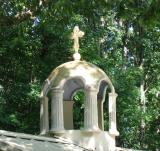 I spent the last couple of days at the Monastery of the Holy Ascension. Lots of trees, lots of quiet. Time to meditate, to read. The monastery is in Resaca, Ga., north of Atlanta, south of Chattanooga. (The abbot joked, when I asked him what ‘Resaca’ meant, that he was pretty sure it meant backwater in some language or another.) I spent a the remains of last night, as it grew dark, reading Austen’s letters. Somehow her brisk chatter with her sister, about buying muslin (what is that, exactly?) and about days spent over tea and in visiting, seemed fitting, even as cassocked monks moved quietly between the bookstore and the kitchen (prosphora was baking, filling the humid air with yeasty scent). Perhaps the reason Austen seemed fitting was because she has a way of writing, on display alike in her letters and her novels, that never uses a him or a her that is not destinate with a thou. She (Austen) and him and her are always on their way to us. Because of this, Austen writes even of strangers with a humorous largeness of spirit, a willingness to be pleased (to mention a notion of Samuel Johnson’s that clearly mattered to Austen: it plays a crucial role in Persuasion), to be familiar. Austen can see, see steadily and wholly, see what is, without succumbing to any need to stand over against who she sees. Such seeing is a benediction, a blessing–a way of responding out of an abyss of respect: for Austen there is always a real person behind the shifting facades, a real person to be seen even in the play of lights of social circumstance, beyond the affectation and hypocrisy, a real person to be seen, and, seen, blessed.
 Quantum Est In Rebus Inane