I take SPACE to be the central fact to man born in America, from Folsom cave to now. I spell it large because it comes large here. Large, and without mercy.
Category Archives: writing
Immortal Openings, 3: Rose Elizabeth Cleveland, The Soliloquies of St. Augustine (Introduction)
The anemic society of today needs not so much the specializing genius–the artist who lives because of his works–as the all-around man, the vital personality whose works live because of him; the man to whom nothing human is alien, whose experience circumscribes and transcends that of the common lot; the prodigious individual rather than the individual prodigy, the master rather than the marvel. Such an one is St. Augustine, once Bishop of Hippo, peerless controversialist, incomparable church father; and once, the dreaming, doubting, half-heathen youth and man, eager of brain, restless of heart, lover of pleasure more than lover of God.
Immortal Openings, 2: Hugh Kenner, The Pound Era
Toward the evening of a gone world, the light of its last summer pouring into a Chelsea street found and suffused the red waistcoat of Henry James, lord of decorum, en promenade, exposing his Boston niece to the tone of things.
Words: Frankenstein and His Monster
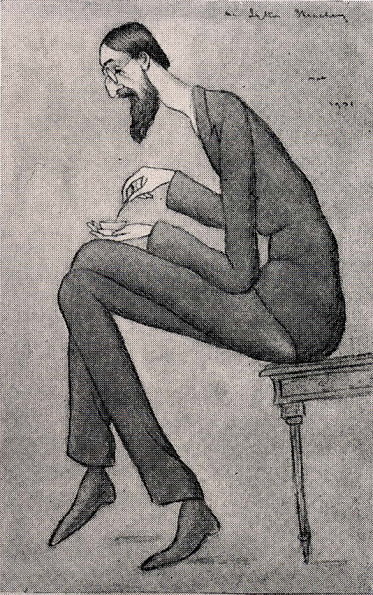
Here’s an interesting passage from Lytton Strachey I ran across this morning. He is writing of words, language:
Those small articulated sounds, that seem so simple and so definite, turn out, the more one examines them, to be the receptacles of subtle mystery and the dispensers of unanticipated power. Each one of them, as we look, shoots up into
“A palm with winged imagination in it
And roots that stretch even beneath the grave.”It is really a case of Frankenstein and his monster. These things that we have made are as alive as we are, and we have become their slaves. Words are like coins (a dozen metaphors show it), and in nothing more so than in this–that the verbal currency we have so ingeniously contrived has outrun our calculations, and become an enigma and a matter for endless controversy. We say something; but we can never be quite certain what we have said. In a single written sentence a hundred elusive meanings palpitate.
Immortal Openings, 1: Robert Byron, Road to Oxiana

My Heroines
Under sedation, the mind does strange things. About the last thought I recall having as I went under on Wednesday was this: “Huh. My favorite characters in novels are all women, all much alike. Fanny Price (Mansfield Park) Anne Elliot (Persuasion), Little Dorrit (Little Dorrit), Molly Gibson (Wives and Daughters). My heroines. What does that reveal about me?” I don’t recall giving an answer. I don’t really have one now.
Moral Kangaroos
A key passage (and one of my favorites) from Gaskell’s Wives and Daughters. Cynthia is talking to Molly.
“Nonsense, Molly! You are good. At least, if you are not good, what am I? There’s a rule-of-three sum for you to do! But it’s no use talking; I am not good, and I never shall be now. Perhaps I might be a heroine still, but I shall never be a good woman, I know.”
“But do you think it easier to be a heroine?”
“Yes, as far as one knows of heroines from history. I’m capable of a great jerk, an effort, and then a relaxation–but steady, every-day goodness is beyond me. I must be a moral kangaroo!”

When Spam Becomes Poetry
Among my spam comments this morning:
Just, the post is genuinely the greatest on that precious topic. I harmonise with your conclusions and also can thirstily appear forward to your incoming updates. Simply saying thanks absolutely will not basically just be sufficient, for the extraordinary lucidity in your writing. I will absolutely quickly grab your rss feed to stay abreast of any kind of updates. Genuine work and also much success in your business endeavors!
“Glory to God in the highest, and on earth peace, good will toward men” (Marcel)

My post on combative clarity (immediately below) was in part, and roundaboutly, a reaction to a point made in the closing sections of Marcel’s Introduction to The Mystery of Being. He summarizes the point so: Philosophical research is “research wherein the link with the result cannot be broken without loss of all reality to the result.”
I want to attend again to that Introduction. It ends in a way particularly appropriate to the Nativity season. Marcel mentions the notion of good will found in the Gospels, and goes on:
It would be folly to seek to disguise the fact that in our own day the notion of ‘the man of good will’ has lost much of its old richness of content, one might even say of its old harmonic reverberations. But there is not any notion that is more in need of reinstatement in our modern world. Let the Gospel formula mean “Peace to men of good will” or “Peace through men of good will,” as one might be often tempted to think it did, in either case it affirms the existence of a necessary connection between good will and peace, and that necessary connection cannot be too much underlined. Perhaps it is only in peace or, what amounts to the same thing, in conditions which permit peace to be assured, that it is possible to find that content in the will which allows us to describe it as specifically a good will. ‘Content’, however, is not quite the word I want here. I think rather that the goodness is a matter of a certain way of asserting the will, and on the other hand everything leads us to believe that a will which, in asserting itself, contributes towards war, whether war in men’s hearts or what we would call ‘real war’, must be regarded as intrinsically evil. We can speak then of men of good will or peacemakers, indifferently.
A philosophy of peace, a weapon of peace–that is Marcel’s thinking. Marcel writes philosophy so as to seek peace and ensue it. –There are less noble motives.
Understanding a Philosopher 2: Bollnow’s Question
Otto Bollnow’s essay, “What does it mean to understand a writer better than he understood himself?”, begins like this:
In the interpretation of philosophical texts and literary works we often encounter the saying that it is important to understand the writer better than he understood himself. At first this saying appears presumptuous. If to understand another means to duplicate his experience, then only the one who had the experience can best know what he means by what he says; and perfect understanding would be the exact duplication and reproduction of what was immediately present in the one who had the experience. We can see how far we fall short of such perfection when we consider how weak the spoken word is as an image of actual life, and how much weaker still is the written word, which lacks the support of physical gesture or facial expression. Thus the claim to understand a writer better than he understood himself seems frivolous and presumptuous.
And yet this maxim recurs unavoidably in the concrete work of textual interpretation. It is, perhaps, not taken quite seriously; it carries a faint undertone of self-irony — but it genuinely expresses a recurring situation in textual interpretation. We must ask: does this saying, which at first appears presumptuous, actually express a legitimate aim of textual interpretation?
Bollnow answers answers his question by (first) noting that normally the answer is that “there is something correct” about the maxim, but that the answer is given while the answerer shuffles his feet: it “cannot be asserted with complete seriousness”. But, even so, the answerer takes the maxim to point to a significant and important problem in interpretation. Bollnow, however, does not rest with this recitation of the normal answer. He goes on (second) to underscore that treating the maxim as somehow or other correct too often forestalls allowing the “uncanniness” of the maxim to show itself. Better, Bollnow thinks, to allow the maxim to sink into us, to allow it to show itself as uncanny, to allow it to reveal something of importance about products of the human spirit.
More soon.
 Quantum Est In Rebus Inane