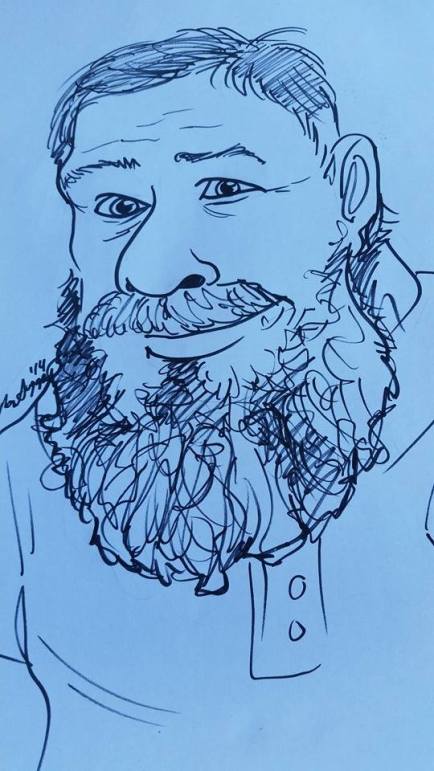
Caricature, Me
The Long Hello
“Truth may be flashed out by one blow”, no doubt, but it is more often won by the slow gestation and maturing of normal experience. Spiritual truth, certainty of God, the immense significance of Christ, the living contacts of the Holy Spirit, are attained as appreciation of beauty is attained, as artistic taste is gained, as tact is acquired, as moral insight is won, by the slow accumulation of experience which saves its gains and out of them builds a character that knows by second nature. –Rufus Jones, The Mysticism in Robert Browning
Seeing, Reading, Saying, Being: A Note from Josh Blog
Some days, between trying to get it right, trying too hard to make it come out right, and not being able to wait for it to strike me in the right way, interpretation wearies me, even sickens me, and I feel as if all real interpretation is just seeing and saying, and what I occupy myself with daily is instead nothing but saying I see, seeing if I can say, reading without seeing, seeing more than I can say, saying what should just be seen, reading instead of saying, saying instead of being. —Little knots of thinking and willing and wishing.
“Love Song: I and Thou”, Alan Dugan (Poetry)
Nothing is plumb, level, or square:
the studs are bowed, the joists
are shaky by nature, no piece fits
any other piece without a gap
or pinch, and bent nails
dance all over the surfacing
like maggots. By Christ
I am no carpenter. I built
the roof for myself, the walls
for myself, the floors
for myself, and got
hung up in it myself. I
danced with a purple thumb
at this house-warming, drunk
with my prime whiskey: rage.
Oh I spat rage’s nails
into the frame-up of my work:
it held. It settled plumb,
level, solid, square and true
for that great moment. Then
it screamed and went on through,
skewing as wrong the other way.
God damned it. This is hell,
but I planned it. I sawed it,
I nailed it, and I
will live in it until it kills me.
I can nail my left palm
to the left-hand crosspiece but
I can’t do everything myself.
I need a hand to nail the right,
a help, a love, a you, a wife.
Philosophical Investigations and Three Kinds of Illusion
I am linking an essay of mine that has been hanging out in my Huh? File. That is, the file in which I put things I have written whose merits and demerits are unclear to me, or so nearly even that I cannot decide whether to invest any more effort in them. I wrote this for viva voce delivery. I don’t know that it deserves further work, deserves my trying to make it a full-on scholarly essay. If any of you have the time and the curiosity to read this, let me know what you think. Thanks in advance!
“An Invitation to Love”: A Smidgen on Twin Peaks

It is that time again, that time of the year when I rewatch *Twin Peaks*, that time of the year when the owls are not what they seem.
I have been thinking a little about the role of the internal soap opera, “An Invitation to Love” in *Twin Peaks*. It’s a structure Lynch likes, an embedded object of comparison for the embedding object. What is “Invitation” doing embedded there?
Certainly the embedding show, *Twin Peaks*, has the superficial structure of a soap opera: lots of beautiful characters, presented in kaleidoscope, constantly at work but never working, with little to do in their afternoons; melodramatic dialogue; romantic and monetary entanglements of extraordinary historical and momentary complication; etc. “Invitation” ironizes this structure, and in so doing, asks the audience: What is the difference between *Twin Peaks* and “Invitation”–and, more pointedly–what are the differences between aiming at art and aiming at entertainment?
That question gets its point from the risks *Twin Peaks* runs. It aims at art. “Invitation”, at best, aims at entertainment. Lynch invites us feel the differences in those aims, the differences in the risks run. For example, the risks run in aiming at entertainment are fewer and less severe in part because entertainment can be formulaic, and often is. That there is a formula does not mean that everyone can succeed at it, do it, but it helps. Put it this way: the rules of entertainment are external to the making of the object that is to entertain. It is possible to consult the rules. But the risks run aiming at art are more numerous and more severe. Art is not formulaic: the rules of art are internal to the making of the object that is to be appreciated. There are rules; but they cannot be consulted. They come to be as the art object comes to be. (This is one reason medium matters in art as it does not (in a way that it does not) in entertainment. Entertainment shows a possibility of a medium, but art shows the conditions of a possibility of the medium: entertainment ’empirically idealizes’, art ‘transcendentally idealizes’.) Lynch also wants us to feel the differences in the demands made on us by *Twin Peaks* and by “Invitation”. Entertainment requires an audience but it does almost all the work for that audience–there is no need for the audience to do work in order to be entertained (in fact, doing work and being entertained typically exclude one another). But art requires appreciators who are, in a limited way, collaborators, who are working in order to appreciate–who are bringing knowledge and experience and understanding and sensory refinement to bear on the art object. Lynch wants us to recognize that watching *Twin Peaks* makes that sort of demand on us. “Invitation” does not.
(I mean this to apply to the first season and part of the second. It is a shame that the second season of *Twin Peaks* sinks into “Invitation”. I wonder if that is why “Invitation” seems to disappear in the second season–it disappears into ubiquity, swelling from object of comparison to form?)
While of course Lynch cannot withstand comparison to Shakespeare (but, then again, who can?), it is worth considering how the relationship between *Twin Peaks* and “Invitation” shares features of the relationships between Shakespeare’s source materials and his plays, and the alchemical, metabasis eis allo genos changes that the source materials undergo as they reappear in the plays. Often enough, Shakespeare made art out of entertainment, body and blood out of bread and wine.
Words, Words, Words: Videos
Happy Birthday to Kierkegaard!
I smoked a cigar in his honor today.
Here’s something from Johannes Climacus:
So there I sat and smoked my cigar until I drifted into thought. Among other thoughts, I recall these. You are getting on in years, I said to myself, and are becoming an old man without being anything and without actually undertaking anything. On the other hand, wherever you look in literature or in life, you see the names and figures of celebrities, the prized and highly acclaimed people, prominent or much discussed, the many benefactors of the age who know how to benefit humankind by making life easier and easier, some by railroads, others by omnibuses and steamships, others by telegraph, others by easily understood surveys and brief publications about everything worth knowing, and finally the true benefactors of the age who by virtue of thought systematically make spiritual existence easier and easier and yet more and more meaningful—and what are you doing?
 Quantum Est In Rebus Inane