Depsychologizing (the Erotic)

I have spent the better part of the last twelve years or so worrying about what it is to psychologize and to depsychologize something.  This has provided a specific focus for much of what I have written on Wittgenstein, who is, I believe, the master of masters of depsychologizing, master even of Frege.  I take very seriously Cavell’s notion that PI’s business is depsychologizing psychology, both one’s own  and others’.

A focus on Frege-influenced forms of depsychologism (re:  mathematics, logic) can hide the ubiquity of what Martin Buber, in a fascinating little essay, “On the Psychologizing of the World”, calls Naive Psychologism.  What he gives this title could be regarded as a form of egotism (where that is a moral failure) but that is not quite what or at any rate quite all that he is talking about.  What he is talking about rather is what we might call a common picture of oneself as beginning and ending at the skin, at the edge of the body.  What matters, all that could matter, is what happens on or under our skin.  That is all we’ve got.  Now, the Naive Psychologizer does not understand what happens on or under our skin in a clearly physical way; he is not clearly thinking of surface irritations or stimulations, or of sub-epidermal electrochemical events.  (If he were, he’d perhaps be moving in the direction of what Buber calls Scientific Psychologism.)  He is thinking of what happens “in his head”, of what he feels “inside”.  (Think of Naive Psychologism as a coarse empirical idealism.)  This is  what matters. And if anything outside the skin matters, that is only really a function of something on or under the skin mattering.

Buber asserts this Naive Psychologism has affected even the erotic.  Our erotic lives have become about nothing more than successive, differentiated “inside” feelings; the erotic partner’s role is to excite those feelings, and if the partner’s “inside” feelings matter, it is only for the sake of insuring more or future “inside feelings” for us.  (And of course we may have good “inside” feelings because they are having good “inside” feelings.) The possibility that the erotic could be a form of conversation–dialogue, a meeting of persons–and not merely a causal transaction (a hook up) is barely, if at all, imaginable. That it could edify the persons, well, that is unimaginable.  The erotic can satisfy, perhaps, on an “inside” model of that; but it cannot upbuild.

I mention this, and I mention Naive Psychologism, because I want to indicate just how easily psychologism comes to us, even in areas of our lives unlikely as locations for psychologism to disport itself.  Naive Psychologism is also important because it reveals that Philosophical Psychologism—about mathematics, logic, psychology—is aided and abetted by a common picture of who and what we are.

Reading “RM” 7: Consciousness

Merleau-Ponty engages one of the most difficult ideas of the essay very near its beginning.  He writes of Montaigne:

Self-consciousness is his constant, the measure of all doctrines for him.  It could be said that he never got over a certain wonder at himself which constitutes the whole substance of his works and wisdom.  He never tired of experiencing the paradox of a conscious being.

Having written that, he turns directly to the task of differentiating Montaigne’s understanding of conscious being from Descartes’.  Montaigne’s understanding is as follows:

At each instant, in love, in political life, in perception’s silent life, we adhere to something, make it our own, and yet withdraw from it and hold it at a distance, without which we would know nothing about it.

Merleau-Ponty terms this adherence and withdrawal, consciousness’ acceptance and alienation, consciousness’ bondage and freedom, “…one sole ambiguous act…”  Descartes understands conscious being differently.  For him, consciousness is not one sole ambiguous act, but rather a pure act:  it does not adhere, accept or become bound.  It is all withdrawal, alienation and freedom.

Montaigne does not know that resting place, that self-possession, which Cartesian understanding is to be.  The world is not for him a system of objects the idea of which he has in his possession; the self is not for him the purity of an intellectual consciousness.

Later in the essay, Merleau-Ponty again contrasts Montaigne and Descartes:

Descartes will briefly confirm the soul and body’s union, and prefer to think them separate; for then they are clear to understanding.  Montaigne’s realm, on the contrary, is the “mixture” of soul and body’; he is interested only in our factual condition, and his book endlessly describes this paradoxical fact that we are.

I take all of this differentiating to be internal to understanding Montaigne’s skepticism.  But before I say anything more about that, and I will by and by, I want to say a little about the differentiating itself.  What exactly is Merleau-Ponty describing, what sort of distinction is he drawing? The answer seems to me to be in the phrase “…one sole ambiguous act…”  For Montaigne, as Merleau-Ponty reads him, to be conscious of something, say of a horse seen through the library window, is to be open to the world, to the horse, even adherent to the horse; the horse is a gift that we accept.  There is no question that what we are conscious of is the horse.  And, being conscious of the horse, there is a sense in which consciousness becomes the horse, incarnates itself in horseflesh.  Yet, in the same act, consciousness withdraws into a kind of distance from the horse, alienates itself from the horse, is free of horseflesh, is utterly discarnate.  But this is not to be decried:  without the distance, the alienation, the freedom, we could not know the horse. “We are equally incapable of dwelling in ourselves and in things, and we are referred from them to ourselves and back again.”  Although Merleau-Ponty puts this in a way that sounds as though it is successive acts, I take him to be describing one sole ambiguous act, and act in which we are all at once all in and all out.   This is the paradox of conscious being.  We are everything and nothing.  We are Gods in nature; we are weeds by the wall.  We are not these by turns, but simultaneously, our conscious being is at each moment one sole ambiguous act.  Montaigne never got over a certain wonder at this, and no wonder.  Montaigne’s consciousness is in one sole ambiguous act a becoming and a knowing; and each requires the other while also being capable (abstractly) of cancelling the other:  to simply become would be to fail to know; to simply know would be to fail to become.  By becoming, we are in a world; by knowing, we find ourselves in that world.  But strangely, again paradoxically, our finding ourselves in the world requires that we not be where we are in the world.  “To be conscious is, among other things, to be somewhere else.”  Somewhere else, of course, contrasts with here, i.e with where I am.

For Descartes, consciousness dwells in itself; consciousness is a resting place.  It possesses itself–but that is all it possesses, since its ideas are crucially creatures of itself.  It is not tied to things, adherent to them.  It remains pure, wholly self-involved.  (This understanding of conscious being is in part responsible for Cartesianism being a gap-displaying method.)  The world of Cartesian consciousness is a system of objects kept by God in the right sort of relation to its ideas.  Cartesian consciousness is all light within; all darkness without.  The Cartesian walks by reason and not by sight.  He has the key to the world.  Montaigne (like Pascal, according to Merleau-Ponty) understands himself as interested in a world he does not have the key to.  For Montaigne, the world is a motley of things of things making an appeal to consciousness, and consciousness in response turns outside while it also faces inside.  The lightness and darkness of Montaigne’s consciousness is a crazy plaid, thrown over inside and outside alike.  Opacity is as much an inside thing as an outside thing.

As a result, achieving self-understanding cannot be circumspectly rotating the oculus mentis around its clean and well-lit place.  It is rather self-questioning, a dialogue with self in which the being who answers is at least partly opaque to the being who asks, and the being who questions must wait for an answer, “…a questioning without which reason’s purity would be illusory and in the end impure…”  Purifying reason requires self-questioning, not merely “visual” self-inspection.  It happens over time, not all at once, and it never results in any final purity, but must be done again and again, day after day, as Socrates did it in the Agora, and once, outside Athens’ walls, under a tree with Phaedrus.  “Phaedrus, my friend!  Where have you been?  And where are you going?”

“Objects of Comparison”: St. John the Evangelist’s Method

One marked characteristic of the mind of the Evangelist, or of the Beloved Disciple, is worth mention.  He often records argument in debate, but he does not argue from premises to conclusions as a method of apprehending truth.  Rather he puts together the various constituent parts of truth and contemplates them in their relations to one another.  Thus he seems to say “look at A; now look at B; now at C; now at B C; now at A C; now at D and E; now at A B E;  now at C E”, and so on in any variety of combination that facilitates new insight.  It is the method of artistic, as distinct from scientific, apprehension, and is appropriate to truth which is in no way dependent on, or derived from, other truth, but makes its own appeal to reason, heart and conscience.

William Temple, Readings In St. John’s Gospel, xxi-xxii

Some Preparatory Remarks for a Class

There are no shallows in philosophy, no knee-deep, shoreline waters.  It is abysmal from horizon to horizon.

Nothing we read will be textbook-like.  That is, nothing we read will begin easy, with starters, and proceed gradually through middling difficult intermediates, and on to truly difficult finalities.  So you will not likely get better as you read straight ahead.  You get better backtracking, as you re-read:  the intermediates come into view on a second or third reading; the finalities only after long frequentation, sometimes life-long re-readings.  (You must learn to cultivate the pleasures while overcoming the challenges of re-reading!)  Re-reading is the analog, in reading philosophy, of working through a textbook.

To make progress in philosophy, you need a high confusion threshold.  You have to be capable of being, willing to be, thoroughly confused without falling into despair.  And you have to be willing to enter into confusion again and again, even while not seeing any exit from it.  The exit, if there is one, is always “across a step or two of dubious twilight” (to borrow a phrase from Robert Browning).  No one who refuses to enter, or who will make no settlement in that twilight, that confusion, will ever be a philosopher.

Slow Down…

I face two new preps this Fall and it is time to begin to give them more attention.  So expect slower posting for the foreseeable future.  In the next couple of weeks I intend to finish the “Reading ‘Reading Montaigne'” series and to round out the discussion of Church-Man’s skepticisim (to some extent that is one project, not two).  I also hope to continue with other topics too–Availability, Problem/Mystery, Marcel, Kierkegaard, etc.  I am thankful for those of you who have been reading the blog and especially to those who have commented.

A Little Dialogue on Carnapian Names

That man’s name is “Smith”.
–Oh, so that’s the name of his name.  But what’s his name?
I told you.  His name is “Smith”.
–Look, I don’t mean to be rude, but could you please answer my question.
I did.  I said: “That man’s name is “Smith”.”
–Oh, so you are now naming something else?  What are you doing?  What is that the name of, if it is a name?  I want to know the man’s name.
But, look, I told you.  When I said ‘ “Smith” ‘ I told you his name.
–That’s not his name.  It is not even the name of his name.  It is the name of his name’s name.  We are making no progress.  Are those tortoise shell glasses?
Damn.  Hey, Smith, come here and help me.
–Oh, <sigh> thanks.  Now I know his name.
Gawd.  Saying and showing.  FML.

(inspired by Anscombe and Lewis Carroll)

The Peculiar Fate of Reason

Does any book open more occultly?

Human reason has this peculiar fate that in one species of its knowledge it is burdened by questions which, as prescribed by the very nature of reason itself, it is not able to ignore, but which, as transcending all its powers, it is also not able to answer.

What is Kant thinking?  Why affright the reader in the first sentence?  “Hear your fate:  You will ask questions that you are required to ask and that you are not permitted to ignore; but you will not be able to answer those questions—they are too much for you, you are too limited, too weak.”  So why read on?  The requirement to ask will not be relaxed.  You will have to ask, have to pay attention.  Your powers will not enlarge, grow.  So why read on?  What is the value of reason if this is true of it?  Is reason, too, broken, like everything else about us?

It is easy to think of Kant as reason’s champion, its scarf affixed to his armor, a colorful declaration, as he jousts with speculative metaphysics.  But that is not quite right.  Shake up CPR; shuffle its Table of Contents.  Imagine, if you will, a Noumenal Table.  The Antinomies would come first, syllogistically displaying the peculiar fate of reason.  (If I remember correctly, Gabriele Rabel more or less arranges contents this way in his book of selections (Kant)—or at least he talks about the preferability of so arranging them.)  The reason Kant seeks to understand is not divine; it is human; it is antinomian.  Nothing divine could be fated for such perverse knottedness, such abyssal self-conflict, such stopless restlessness.  Reason can be, must be, Critized.  But, even Criticized, reason is not divinized.  It recognizes what it is but cannot stop being what it recognizes itself to be.  By ascesis, by discipline, it can cease asking unrequired questions, and it can come to see the peculiarity of the required questions.  But that’s all.  What is the value of reason?  Well, it has value.  It serves us well empirically, here under the sun.  But it lacks the fullness of value we could have attributed to it when we thought it divine (as perhaps the Greeks did).  CPR teaches a skepticism about human reason, even as it attempts to subjugate Humean skepticism.

Since I have mentioned the chiastic structure of TLP and PI, let me note that the Antinomies are placed by Kant at what could be regarded as the crux of CPR, at its dialectical middle.  That is a way, on a chiastic scheme of organization, of placing the Antinomies first.  Anyway, the book begins with the Antinomies furled into a remarkable sentence, a sentence that is unfurled across the length of the book.

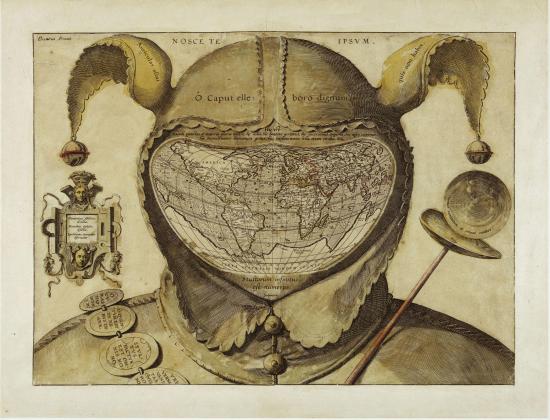
The Fool’s Cap Map of the World

A Cartographical Oddity, A Mascot for this Blog

This startling and disturbing image is one of the enigmas of cartographic history. The artist, date and place of publication are all unknown, and one can only guess at its purpose. The geography of the map strongly resembles that of the world maps of Ortelius published in the 1580s, giving a tentative date of c. 1590. This is the earliest known use of the world map in a visual joke. Its central visual metaphor is the universality of human folly and various mottoes around the map reinforce that theme. The panel of the left says: “Democritus laughed at it [i.e. the world], Heraclitus wept over it, Epichtonius Cosmopolites portrayed it.” Although Epichtonius Cosmopolites appears to be the author’s or artist’s name, it translates roughly as “Everyman,” leaving the mapmaker’s true identity hidden.

A strong legacy of the theme of the Fool exists in literature and popular art from the fourteenth to seventeenth centuries. The Fool was licensed to break rules, speak painful truths and mock power and pretension, and the grotesque shape he bore was a kind of living punishment. This frame of reference would have been quite familiar to the audience of this engraving in the 1590s. And people would have recognized in this map a radical visual interpretation of the Fool’s role: it is now the whole world that takes on the Fool’s costume.

Adapted from the book The Image of the World: 20 Centuries of World Maps by Peter Whitfield (Pomegranate Artbooks, 1995)

The Structure of Philosophical Investigations (and the Tractatus)

Here are a couple of paragraphs from a current draft of a paper of mine.  It touches on a point I have been concerned to make in more than one place of late, a point about the structural similarity of TLP and PI.

In TLP and PI, the concentration of metaphilosophical remarks occurs in the dialectical middle (a middle not necessarily the same as its paginal middle): the 4s in the TLP and in 89-133 in PI. Rhetorically, each of the books is a large epanados, a chiasmus. That is, each of the books is organized spatially around a center or middle. Each book has the structure, roughly, of a large ‘x’, with the metaphilosophical remarks stationed at the crux of the ‘x’. (A handy example of a small epanados is Unamuno’s false but memorable sentence, “Martyrs create faith, faith does not create martyrs.”) The similar chiastic structures of the two books has not been stressed as it should be.

Placing the remarks as Wittgenstein does is a broad hint about how not to understand them. It is a broad hint not to think, among other things, that the remarks can be understood in isolation from the other non-metaphilosophical remarks that stand to the left of them and to the right of them. I like to think of PI as unified by both a centripetal and a centrifugal energy, the first the movement of the left-hand and right-hand remarks inward toward the center, and the second the movement of the center outward toward both the left-hand and right-hand remarks.