Reading (the Psalms): Mother Maria

From the Preface to The Psalms:  An Exploratory Translation:

I had studied the Psalms, form, rhythm, content, historical background, as they were sung from age to age, in liturgical harmony, of joy and of grief, by Old Israel; and the distant, unhalting psalmody in the Orthodox Church had often carried me to the shores of eternity, where my prayer could come to rest; and for many years I had myself recited the Psalms in the monastic Offices.  But, one day, I was roused as if out of a slumber, and with sudden, violent clarity I knew that I did not know the Psalms; that, what I knew, was but a surface, or what I myself projected into the Psalms; it was not the life of the Psalms.  And I was ashamed.

Could it not be that each Psalm had a face, a personal face, a particular, unique life, which had remained hidden from me within the eternity flow of liturgical prayer?  I must seek it; but how could I find it?

Could I go back, and yet further back, word by word, listening, delicately, with held breath?  Would then the Psalm let me enter, and allow me, from the inside, to experience it, as if for the first time?

A striking, striking passage.  It captures a feeling I believe we have all had when reading books that matter to us.  We become ashamed of ourselves as readers, know that we have not read with the needed discipline, know that we know only a surface, not the hidden life of what we read.  We need a new pitch of attention to find that life:

Could I go back, and yet further back, word by word, listening, delicately, with held breath?

Enforced Quiet

I spent the last couple of days at the Monastery of the Holy Ascension.  Lots of trees, lots of quiet. Time to meditate, to read.  The monastery is in Resaca, Ga., north of Atlanta, south of Chattanooga.  (The abbot joked, when I asked him what ‘Resaca’ meant, that he was pretty sure it meant backwater in some language or another.)  I spent a the remains of last night, as it grew dark, reading Austen’s letters.  Somehow her brisk chatter with her sister, about buying muslin (what is that, exactly?) and about days spent over tea and in visiting, seemed fitting, even as cassocked monks moved quietly between the bookstore and the kitchen (prosphora was baking, filling the humid air with yeasty scent). Perhaps the reason Austen seemed fitting was because she has a way of writing, on display alike in her letters and her novels, that never uses a him or a her that is not destinate with a thou.  She (Austen) and him and her are always on their way to us.  Because of this, Austen writes even of strangers with a humorous largeness of spirit, a willingness to be pleased (to mention a notion of Samuel Johnson’s that clearly mattered to Austen:  it plays a crucial role in Persuasion), to be familiar.  Austen can see, see steadily and wholly, see what is, without succumbing to any need to stand over against who she sees.  Such seeing is a benediction, a blessing–a way of responding out of an abyss of respect:  for Austen there is always a real person behind the shifting facades, a real person to be seen even in the play of lights of social circumstance, beyond the affectation and hypocrisy, a real person to be seen, and, seen, blessed.

Reading “RM” 4: Starting on Skepticism, Cartesian and Pyrrhonian

Montaigne’s Book III essays are crossroads of skepticisms.  As a way taking up Merleau-Ponty’s take on Montaigne’s skepticism, I want to say a little about the skepticisms that I do not find as such in Montaigne.

Cartesian Skepticism.  I certainly do not mean by this that there are no moments of epistemological skepticism in Montaigne.  There are.  But they are not Cartesian, as I understand Cartesian skepticism.  Cartesian skepticism incorporates a method, first and paradigmatically exampled in the Meditations. The crucial phenomenological feature  of Cartesianism—namely the gap it finds between itself and the world—is the residue of the method.  I do not mean that the gap is methogenic, in Marvin Farber’s term, i.e., an artificial and properly discountable effect of the method itself, one overcome not by solving it within the confines of the method, but enlarging the conception of method, so that the feature vanishes, much like certain optical illusions do when we allow ourselves to get up and walk around the source of the illusion, instead of staring fixedly at it. No, I am not claiming that the Cartesian’s gap is methogenic. But I do want the connection between the method and the gap to be clear:  the Cartesian method is a gap-displaying method.  But in Montaigne, even in his moments of epistemological skepticism, no gap yawns. And, even more clearly, there is little if any method of any Cartesian sort in Montaigne’s moments of epistemological skepticism.  We need to understand such moments; but treating them as speciations of Cartesian skepticism will not help us.

Pyrrhonian skepticism.  Montaigne favors epistemic modesty but he is not advocating epistemic chastity, an epistemic policy of withholding of assent (whether it is withheld generally or only in the face of a particular class of propositions). One reason why disentangling Montaigne from Pyrrho is tricky is that Montaigne’s skepticism permeates him, permeates what he takes to be an artful, and so happy, life.  Call this the existential demand of Montaigne’s skepticism.  Pyrrhonism makes its own existential demand.  (Cartesian skepticism makes no existential demand. In fact, in the argumentative economy of the Meditations Cartesian skepticism not only makes no existential demand, but it is crucial that its making an existential demand is not fully intelligible.)  The state that the Pyrrhonian seeks to cultivate, call it a state liberated from the coils of dogmatism, differs from the one that Montaigne seeks to cultivate, although he is no fan of dogmatism.  I will investigate that difference when I turn to characterizing Montaigne’s skepticism positively.

Johnson on Affectation and Hypocrisy

Johnson knew how to make distinctions.  From Rambler 20:

Affectation is to be always distinguished from hypocrisy, as being the art of counterfeiting those qualities which we might, with innocence and safety, be known to want.  Thus the man, who, to carry on any fraud, or, to conceal any crime, pretends to the rigors of devotion, and exactness of life, is guilty of hypocrisy; and his guilt is greater, as the end, for which he puts on the false appearance, is more pernicious.  But he that, which an awkward address, and unpleasing countenance, boasts of the conquests made by him among the ladies, and counts over the thousands, which he might have possessed, if he would have submitted to the yoke of matrimony, is chargeable only with affectation.  Hypocrisy is the necessary burden of villainy, affection part of the chosen trappings of folly; the one completes a villain, the other only finishes a fop.  Contempt is the proper punishment of affectation, and detestation is the just consequence of hypocrisy.

Reading “Reading Montaigne” 2

A few more preliminary matters.

I had the good fortune, a few weeks ago while in Bordeaux, to visit Montaigne’s Chateau.  I have venerated the man and his work for many years.  That I visited while taking part in a small conference devoted to Thompson Clarke’s “The Legacy of Skepticism”, and so a conference devoted more broadly to the problem of skepticism, made the visit reverberate existentially even more than it would have.  I guess you could say I was vulnerable to the call of Montaigne in a way I was unprepared for, even though I was excited to go and expected the visit to be meaningful.

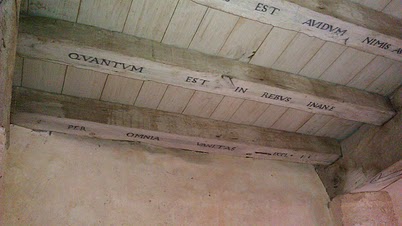
At one point I stood in Montaigne’s library, described by him in considerable detail late in “The Kinds of Association”.  The library’s ceiling was openly crosshatched by large, rough beams, into which Montaigne had carved his favorite sayings in Greek and Latin.  The first beam in the central section of the ceiling bore, “Per omnia vanitas”, the second, “Quantum est in rebus inane” (the title of this blog).  I hardly exaggerate when I say that this blog began in Montaigne’s library, as I stood beneath those beams to take a photograph.  Various seeds of ideas I have carried a long time, many planted long ago by my teacher, Lewis White Beck, during countless mornings over coffee, watered by Thompson Clarke and the conference, were given the increase by Montaigne and his library.  I am still—obviously—working to find a way to say something about what began growing that day and am still jealously guarding its continued growth.  It is always dangerous to speak, to write, too early:  but sometimes speaking, writing, is itself necessary to find your way to what you have in you to say.  (Don’t folks talk to plants to make them grow?)

A Montaigne essay is a field of interest.  (Emerson learnt this from Montaigne.)  It is a field of interest in which he participates disinterestedly.  The field of interest has a focal object (now concrete, now abstract), and Montaigne writes out of an intent absorption in that object.  It is Montaigne’s profound interest in the focal object that makes possible his disinterestedness.  This is crucial.  So often the focal object of Montaigne’s field of interest is himself; that does not forestall disinterestedness.  Montaigne drives his essays forward by means of a sustained willingness to re-encounter his focal object; one look does not suffice, he vets first impressions.  The instinct authority of the focal object obliges his experience—but the focal object does not reveal itself fully or declare the whole of its authority at any single moment of experience.  Montaigne will suffer contradiction or the appearance of contradiction rather than to disoblige his experience.  All this makes writing about Montaigne hard.  He writes what he writes where and when (in the essay) he writes it, addressed to whatever his focal object happens to be.  Quoted outside of that essayistic location, outside of that address to the focal object, what Montaigne has written is not clearly what he has written.  Sentence after sentence seems designed for citation.  But it is unclear any can survive it.  The fish that glinted multipotently beneath the water, in rainbow extravagance, is in one sense the same fish that lies in bleak grey contortion on the wet deck.  But is it in every sense the same fish?  (Emerson will push this phenomenon of quotable unquotability even further in his own way, as will Cavell in his own, different way.)

Marcel on Popular Philosophy

A nice portion of Marcel:

…[S]ome scraps of philosophical thought conveyed through newspapers, magazines and ordinary conversations find their way to one extent or another into all minds.  Most of the time these scraps could just as well be burned like household garbage, and it is perhaps one of the more important functions of true philosophical thought to carry out this kind of trash-burning.

Reading “Reading Montaigne” 1

Before turning to “Reading Montaigne”, I want to notice passages from Merleau-Ponty’s talk, “In Praise of Philosophy”.  It seems clear that Montaigne is in his mind throughout the talk, and evidence of this occurs just at its end:  Montaigne is given the final (quoted) words of the essay.  But earlier there are passages that provide undeclared portraiture of Montaigne.

The philosopher is marked by the distinguishing trait that he possesses inseparably the taste for evidence and the feeling for ambiguity.  When he limits himself to accepting ambiguity, it is called equivocation.  But among the great it becomes a theme; it contributes to establishing certitudes rather than menacing them.  Therefore it is necessary to distinguish good and bad ambiguity.  Even those who have desired to work out a completely positive philosophy have been philosophers only to the extent that, at the same time, they have refused the right to install themselves in absolute knowledge.  They taught not this knowledge, but its becoming in us, not the absolute but, at most, our absolute relation to it, as Kierkegaard said.  What makes a philosopher is the movement which leads back without ceasing from knowledge to ignorance, from ignorance to knowledge, and a kind of rest in this movement…

And:

The enigma of philosophy (and of expression) is that sometimes life is the same to oneself, to others, and to the true.  These are the moments which justify it.  The philosopher counts only on them.  He will never accept to will himself against men, nor to will men against himself, nor against the true, nor the true against them.  He wishes to be everywhere at once, at the risk of never being completely anywhere.  His opposition is not aggressive; he knows that this often announces capitulation.  But he understands the rights of others and of the outside too well to permit any infringement.  If, when he is engaged in external enterprises, the attempt is made to draw him beyond the point where his activity loses the meaning which inspired it, his rejection is all the more tranquil in that it is founded on the same motives as his acceptance.  Hence the rebellious gentleness, the pensive engagement, the intangible presence which disquiets those who are with him.  As Bergson said of Ravaisson in a tone so personal that one imagines him to be speaking of himself:  “He gave no hold…He was the kind of man who does not offer sufficient resistance for one to flatter himself that he has ever seen him give way.”

The first passage bears importantly on the discussion of Montaigne’s skepticism (and so of his knowledge and his ignorance) in “Reading Montaigne” (“RM”), so I will be thinking of it when I get to that particular, difficult juncture.  Also, and related, both passages could be said to be portraiture of Socrates as well as of Montaigne.  In fact, just a bit later in the essay, Merleau-Ponty writes “We must remember Socrates” as the copestone for the section. But Merleau-Ponty’s Socrates shadows Montaigne’s Socrates.  Remember that Socrates finally eclipses various other heroes of Montaigne (like Cato the Younger) by the time of the essays in Book III, so it will be hard to describe Montaigne as he appears in them without also to some extent describing Socrates as he appeared then to Montaigne.  (By the way, since I have conjoined Socrates and Montaigne here, I note that the second passage instructively relates to my ongoing discussion of disposibility and that I in part chose it for that reason.  Oh, and one other parenthetical item, since I have mentioned Socrates:  I recall that Pierre Hadot makes interesting use of this talk of Merleau-Ponty’s in some of his work on Socrates, for example in What is Ancient Philosophy?)  I will later notice another passage from the talk when I discuss the section on Montaigne’s religion in “RM”; what Merleau-Ponty says of Socrates’ religion elucidates what he says of Montaigne’s.

I judge “RM” to have the following structure:  Introduction, Montaigne’s skepticism, Montaigne’s religion, Montaigne’s skepticism, and a critical summation of Montaigne, weaving all the earlier discussions together.  My hope is to take up first Montaigne’s skepticism, second his religion, third his stoicism, and finally to take up the summation.

Wittgenstein in Christian Categories?

Here are the final few paragraphs from an essay of mine (forthcoming soon in a volume of Orthodox philosophers):

Lately, I have been attempting to transfigure my understanding of Wittgenstein’s Philosophical Investigations. I have been attempting to understand Wittgenstein’s philosophizing in Christian categories. I believe there is hope for such an understanding. Wittgenstein himself said that he could not help seeing philosophical problems from a religious point of view. Of course, it is not perfectly clear what he meant by saying that, but he certainly could have meant that his work can be understood, maybe even that it is best understood, in Christian categories. (I little doubt that ‘religious’, for him, meant Christian, or at least Judeo-Christian.) I am currently telling myself that the key Christian categories for understanding his work are prelest and podvig.

Consider: “And the Lord God said unto the woman, ‘What is this that thou hast done?’ And the woman said, ‘The serpent beguiled me and I did eat’”Genesis 13: 3.

‘Prelest’: the nearest English equivalent is ‘beguilement’ or ‘bewitchment’— but the meaning of the term seems to be simultaneously somewhat broader and more technical, and so it is best to leave it untranslated. Bishop Ignatiy Brianchaninov thematized ‘prelest’ as the corruption of human nature through the acceptance by man of mirages mistaken for truth. We are all in prelest. I hope the nearest English equivalents show the suitability of the term for discussing Philosophical Investigations. Wittgenstein employs prelest-language throughout the book: ‘bewitchment’, ‘temptation’, ‘superstition’,‘illusion’, ‘scruples’, ‘picture’, ‘haze’, ‘fog’, ‘chimera’, ‘sham’, ‘dazzlement’, ‘preconceived idea’, ‘false appearance’, ‘latent nonsense’, etc. But Wittgenstein target is not spiritual prelest generally, but rather cognitive prelest specifically. (Cognitive prelest is a species of spiritual prelest—so I think and so I think Wittgenstein thought.) We are all in cognitive prelest.

‘Podvig’: the nearest English equivalent is the phrase ‘ascetic struggle’ or, perhaps, ‘moral heroism’—but the meaning of the term is, again, somewhat broader and more technical than these phrases, so I leave it untranslated. Here is a use of the term by Bishop Theophan the Recluse:

The true Christian tests himself every day. Daily testing to see whether we have become better or worse, is so essential for us that without it we cannot be called Christians. Constantly and persistently we must take ourselves in hand. Do this: from the morning establish thoughts about the Lord firmly in your mind and then during the whole day resist any deviation from these thoughts. Whatever you are doing, with whomever you are speaking, whether you are going somewhere or sitting, let your mind be with the Lord. You will forget yourself, and stray from this path; but again turn to the Lord and rebuke yourself with sorrow. This is the podvig of spiritual attentiveness.

What Wittgenstein demands of himself and his reader is the podvig of cognitive attentiveness. We must take ourselves in hand and learn the wiles, subterfuges, ruses and stratagems that (our life with) language employs against us. Wittgenstein knows we will forget ourselves, let ourselves slip out of hand: “…in despite of an urge to misunderstand…” He knows we will stray from this path, fail in our attentiveness or have our attentiveness deceived: “A philosophical problem has the form: I do not know my way about.” The point of cognitive podvig is the gradual cognitive self-perfection of the person undergoing it. Because this is the point, and so is the point of Philosophical Investigations, it is hard to answer someone who asks after the point of Wittgenstein’s teaching, and who expects the answer to take the form of a philosophical thesis. To learn from Wittgenstein is to undertake the podvig of gradual cognitive self-perfection via self-attentiveness, self-denial and self-discipline. It is above all to live a certain kind of life of the mind, to practice a demanding discretio, to wage an unseen warfare. It is not above all to advocate philosophical theses.

Although I will not take the time to develop the thought, Wittgenstein’s work can be seen as targeting the Gnostic and the Barlaamite who hides in the heart of the philosopher, as targeting the notion that it is by progress of knowledge that we become wise.  Wittgenstein’s work, if successful, can be seen as opening the possibility of a vision of God that is no intellectual grasp of an external object, but rather an inward participation in the life of the Holy Spirit, a vision in which to see God is to share in the life of the Holy Spirit, to become divinized, not just intellectually, but as a whole person, body and soul. Wittgenstein opens the possibility that philosophy is finally best understood as an orientation towards grace, indeed as a love of grace.

forthcoming in Turning East: Contemporary Philosophers and the Ancient Christian Faith (Rico Vitz, ed.)

Reading “Reading Montaigne”

For a long time now I have wanted to explore Merleau-Ponty’s essay on Montaigne.  I plan to begin to do that here in the next few days.  Merleau-Ponty confines himself (at least for the purposes of quoting Montaigne) to Book III of the Essays.  These essays Donald Frame adjudges “[Montaigne’s] mellowest, his most individual, his most thoroughly human.”  I will confine myself to Book III too, as far as Montaigne goes.  I may, however, make use of more than just Merleau-Ponty’s Montaigne essay; I may sift through some other work by Merleau-Ponty.

What Are You Doing?

I say a little about this, generally, under AIM, above.  But I should mention that a goal of the blog is for the (sometimes slow and quite zigzagging) development of themes that interest me.  So far, I have been trying to follow out what I have called “Church-Man’s Skepticism” and “Disposability”.  About any post title with a number in it, or the words “More on…” or “…Again”, etc., indicate such followings-out.  Often I will supply quotations that will be unexplained but that will, for me, become part of the critical language I want to develop for discussing a theme.  You’ll have to decide if you can bear with me as I do this.  It’s asking quite a bit.