Because the Master of Catholic Truth ought not only to teach
the proficient, but also to instruct beginners (according to the
Apostle: “As Unto Little Ones in Christ, I Gave You Milk to
Drink, Not Meat”—1 Cor. iii. 1, 2), we purpose in this book to
treat of whatever belongs to the Christian Religion, in such a way
as may tend to the instruction of beginners. We have considered
that students in this Science have not seldom been hampered by
what they have found written by other authors, partly on account
of the multiplication of useless questions, articles, and arguments;
partly also because those things that are needful for them to know
are not taught according to the order of the subject-matter, but
according as the plan of the book might require, or the occasion
of the argument offer; partly, too, because frequent repetition
brought weariness and confusion to the minds of the readers.
Endeavoring to avoid these and other like faults, we shall try,
by God’s help, to set forth whatever is included in this Sacred Science
as briefly and clearly as the matter itself may allow.
Category Archives: religion
The Silence of St. Thomas (Josef Pieper)
Mention is rarely made of the fact that the teaching about God in the Summa Theologica begins with this sentence: “We are not capable of knowing what God is, but we can know what he is not.” I know of no textbook of Thomistic thought which contains the notion expressed by St. Thomas in his commentary on the De Trinitate of Boethius, namely that there are three degrees in our knowledge of God: the lowest, the knowledge of God as he is active in creation; the second, the recognition of God as mirrored in spiritual beings; the third and loftiest, the recognition of God as Unknown, tamquam ignotum. Or consider this sentence from the Questiones Disputatae: “This is what is ultimate in the human knowledge of God: to know that we do not know God.”

McCabe on the Trinity
Think for a moment of a group of three or four intelligent adults relaxing together in one of those conversations that have really taken off. They are being witty and responding quickly to each other—what in Ireland they call ‘the Crack’. Serious ideas may be at issue, but no one is being serious. Nobody is being pompous or solemn (nobody is preaching). There are flights of fancy. There are jokes and puns and irony and mimicry and disrespect and self-parody. Now a 7-year old is in the room, completely baffled by it all…Now this child is like us when we hear about the Trinity.
Abbot Theodore and Thoreau
Another brother asked the same elder, Abbot Theodore, and began to question him and to inquire about things he had never yet put into practice himself. The elder said to him: As yet you have not found a ship, and you have not put your baggage aboard, and you have not started to cross the sea: can you talk as if you had already arrived in that city to which you planned to go? When you have put into practice the things you are talking about, then speak from knowledge of the thing itself!
There are nowadays professors of philosophy, but not philosophers. Yet it is admirable to profess because it was once admirable to live. To be a philosopher is not merely to have subtle thoughts, nor even to found a school, but so to love wisdom as to live according to its dictates, a life of simplicity, independence, magnanimity, and trust. It is to solve some of the problems of life, not only theoretically, but practically.
Gerard Manley Hopkins on the Keontic Hymn (Phil 2: 5-11)

Photo by Rowan Gillespie
From The Letters of G. M. Hopkins to Robert Bridges (Letter xcix)
Christ’s life and character are such as appeal to all the world’s admiration, but there is one insight St. Paul gives of it which is very secret and seems to me more touching and constraining than anything else: This mind he says; was in Christ Jesus–he means as man: being in the form of God—that is, finding, as in the first instant of his incarnation he did, his human nature informed by the godhead—he thought it nevertheless no snatching-matter for him to be equal with God, but annihilated himself, taking the form of a servant; that is, he could not but see that he was, God, but he would see it as if he did not see it, and be it as if he were not instead of snatching at once at what all the time was his, or was himself, he emptied or exhausted himself so far as that was possible, of godhead and behaved only as God’s slave, as his creature, as man, which also he was, and then being in the guise of man humbled himself to death, the death of the cross. It is this holding of himself back, and not snatching at the truest and highest good, the good that was his right, nay his possession from a past eternity in his other nature, his own being and self, which seems to me the root of all his holiness and the imitation of this the root of all other moral good in other men.
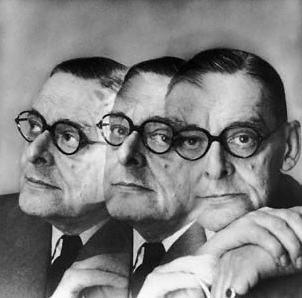
Eliot’s (Religious) Struggle with Words: Leavis
It is a mark of Eliot’s peculiar importance to us—that is, of his major status as a poet of our time—that he should have had his distinctive preoccupation with language. I am thinking of the preoccupation that, with the pressure behind it, is expressed here, in the opening section V of ‘East Coker;:
So here I am in the middle way, having had twenty
years—
Twenty years largely wasted, the years of l’entre
deux guerres—
Trying to learn to use words, and every attempt
Is a wholly new start, and a different kind of failure
Because one has only learnt to get the better of words
For the thing one no longer has to say, or the way in
which
One is no longer disposed to say itThe poet of ‘The Hollow Men’ was clearly a man driven by a desperate need; a need to apprehend with sureness a reality that could compel belief, claim allegiance and create a centre of significance. The association, or identification, of the quest driven by such a need with the unendingly resourceful struggle to ‘get the better of words’ determines the way and the sense in which Eliot’s later poetry is religious.
Now the mode of Ash-Wednesday differs very obviously from that of Four Quartets. Nowhere in it is that anything that challenges the full attention of the waking mind in the blunt, prose-like way of the opening of ‘Burnt Norton’, where we seem to be starting on a metaphysical essay. You might be inclined to say that the insistently liturgical element and the accompanying character of the rhythm—isn’t it incantory?—make a thinking attention to the sense impossible; at any rate, that they don’t demand it; rather, they discourage it. If you said that, you would be showing that, though you might sincerely say that you enjoyed the poetry, you hadn’t really read it. There would be no reason why you should quarrel with Anglo-Catholic expositors who make the poetry something utterly different from what it is, which is something utterly different as religious poetry from (say) Herbert’s. For it is in answering the question, ‘In what sense is this religious poetry?’, that one has to take account of its insistent challenge to the thinking–the pondering, distinguishing, relating–mind.
From The Spiritual Letters of Fenelon
Excerpted from a letter to the Countess of Gramont, March 21, 1692:
Take up again the readings that have touched you. They will touch you again, and you will get more out of them than the first time. Bear yourself without flattering yourself or becoming discouraged. This happy medium is rarely found. We promise ourselves great things of ourselves and of our good intentions, or else we despair of all. Hope for nothing from yourself. Look for everything to God. Despair of our own weakness, which is incorrigible, and unlimited confidence in the power of God, are the true foundations of every spiritual edifice. When you will not have much time to yourself, do not miss making use of the least moments which do remain yours. It does not take much time to love God, to renew yourself in his presence, to lift your heart to him, or to adore him from the depths of your heart, to offer to him what you are doing and what you are suffering. This is the true Kingdom of God within us, which nothing can trouble.
Heading North
Off to the north country: I’ll read my essay, see old friends and former students, enjoy the change of scenery. I will learn a lot, I’m sure. I return to the heart of Dixie on Saturday, I hope in time to celebrate the Paschal Divine Liturgy with my parish.
For those who do not know the Paschal Liturgy, one of its many highlights (and indeed one of my favorite pieces of writing of all time) is John Chrysostom’s Paschal Homily. I post it here:

If any man be devout and love God, let him enjoy this fair and radiant triumphal feast. If any man be a wise servant, let him rejoicing enter into the joy of his Lord. If any have labored long in fasting, let him now receive his recompense. If any have wrought from the first hour, let him today receive his just reward. If any have come at the third hour, let him with thankfulness keep the feast. If any have arrived at the sixth hour, let him have no misgivings; because he shall in nowise be deprived therefor. If any have delayed until the ninth hour, let him draw near, fearing nothing. If any have tarried even until the eleventh hour, let him, also, be not alarmed at his tardiness; for the Lord, who is jealous of his honor, will accept the last even as the first; he gives rest unto him who comes at the eleventh hour, even as unto him who has wrought from the first hour.
And he shows mercy upon the last, and cares for the first; and to the one he gives, and upon the other he bestows gifts. And he both accepts the deeds, and welcomes the intention, and honors the acts and praises the offering. Wherefore, enter you all into the joy of your Lord; and receive your reward, both the first, and likewise the second. You rich and poor together, hold high festival. You sober and you heedless, honor the day. Rejoice today, both you who have fasted and you who have disregarded the fast. The table is full-laden; feast ye all sumptuously. The calf is fatted; let no one go hungry away.
Enjoy ye all the feast of faith: Receive ye all the riches of loving-kindness. let no one bewail his poverty, for the universal kingdom has been revealed. Let no one weep for his iniquities, for pardon has shown forth from the grave. Let no one fear death, for the Savior’s death has set us free. He that was held prisoner of it has annihilated it. By descending into Hell, He made Hell captive. He embittered it when it tasted of His flesh. And Isaiah, foretelling this, did cry: Hell, said he, was embittered, when it encountered Thee in the lower regions. It was embittered, for it was abolished. It was embittered, for it was mocked. It was embittered, for it was slain. It was embittered, for it was overthrown. It was embittered, for it was fettered in chains. It took a body, and met God face to face. It took earth, and encountered Heaven. It took that which was seen, and fell upon the unseen.
O Death, where is your sting? O Hell, where is your victory? Christ is risen, and you are overthrown. Christ is risen, and the demons are fallen. Christ is risen, and the angels rejoice. Christ is risen, and life reigns. Christ is risen, and not one dead remains in the grave. For Christ, being risen from the dead, is become the first fruits of those who have fallen asleep. To Him be glory and dominion unto ages of ages. Amen.
From Kierkegaard, a Lenten Thought
And so there is to be found neither in heaven nor upon earth, nor in any relationship between man and man, an exaltation like this, when I turn away humbled and ashamed from my best deed as from a vileness and find repose in ‘grace’. Let the pagan with his proud neck strike the heavens, or try to–from this humiliation comes the exaltation which blissfully reaches heaven. Thou canst not worship God by good works, still less by crimes, and just as little by sinking into a soft slumber and doing nothing. No, in order to worship a man must so comport himself: he strives with might and main, spares himself neither day nor night, he tries to produce as many as possible of what upright men, humanly speaking, might call ‘good works’. And then when he takes them and, deeply humbled before God, beholds them transformed to wretchedness and vileness, that is to worship God–that is exaltation.
Skepticism: Vain Thinking, 1
A fresh-ish start on a difficult topic. Bear with me.
I take vanity to be the central concept of Montaigne’s writing: it is the concept that joins his Christianity to his skepticism, in fact it is the concept that makes his skepticism Christian. I suppose this claim might be a stumbling block for many, and for a variety of reasons. The one I want to address now is this: “You take the Essays (particularly the Third Book) as deeply colored by Ecclesiastes. For you, the line, “Per omnia vanitas” is the running heading of the Essays. But Ecclesiastes is, remember, a description of life “under the sun”–uncompromising, cold, objective, human–a description of a world without God. So how can Montaigne’s Ecclesiastes-saturated essays be a form of Christian, again: Christian, skepticism?” But that is not how I understand Ecclesiastes. Ecclesiastes I understand as itself revelation: What is shows us is human life as revealed by God. What it shows us is not something we can lift ourselves out of by coming to faith in God, as if faith in God undid the vanity of human life. It doesn’t. God is Mystery; faith is Mystery; and the relationship of both to the vanity of human life is Mystery. That does not mean that we know nothing about God, faith or the relationship of human life to each or both, but it does mean that we cannot make simple, formulaic comments about it. (It is not safe to say, for instance, that the view of human life in Ecclesiastes is one that simply requires the supplementation of grace in order for it to undo its vanity. There’s something right about that, sure; but it is not a matter of simple supplementation.) Human life is vanity. God and faith in God do not change that straightforwardly, although God and faith in God allow for hope and patience in the vanity of human life.
Montaigne’s skepticism is his way of reckoning with the vanity of human life–a vanity still present in human life even when it is lived in Christian categories, a vanity in fact most fully disclosed in such living. This does not mean that human life is devoid of value or of values, but it does mean that those values are, in an important but difficult sense, contradictory. Happiness is vanity; but we should gather such happiness as we can. Work is vain; but we need to work. Neither happiness nor work is fully satisfying, but neither is without value. Their value is enigmatic, contradictory. As such, the role of each in human life is not open to easy survey–and to think either is so open is to fail to reckon with the view of human life God reveals, to fail to remember life’s existential deficiency. (Note that the Preacher of Ecclesiastes, the Church-Man, has had this revealed to him not in ecstatic vision but in the midst of his own life’s striving: “I marked…”, “I found…” “I learned…”. It is important that the book is written first-personally. But what is marked, found and learned is not something that the Church-Man takes himself to have come to know independently of God’s revelation of it to him. What is true under the sun is not anyway available to be known under the sun.)
For Montaigne, as for the Church-Man, knowledge is vain. We should seek it, cannot, in one sense, help but seek it: “There is no desire more natural than the desire for knowledge.” But even when we have it, each of us must ask: “What do I know?…I am an investigator without knowledge.” –No matter what we do, we are all unprofitable servants. –We know what we know, but knowing it does not eliminate our emptiness or neediness, as we expect it to do. Nothing we can know can change what we are, make us new and different and better creatures. More often than not, what we know turns out to be an encumbrance, a burden, a curse; knowing what we know makes us worse. (The Serpent’s lesson, taught in the Garden.) At best, it tends to puff us up. Puffiness is Montaigne’s aversion.
More soon.
 Quantum Est In Rebus Inane