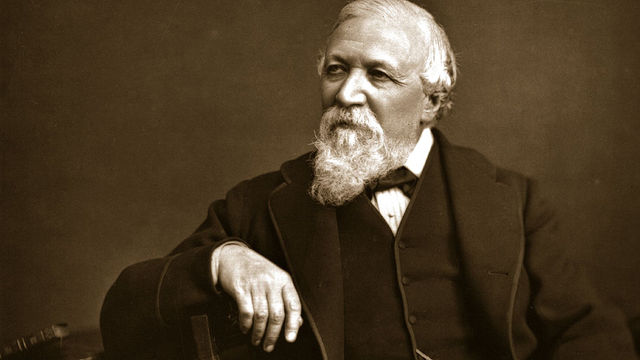
Kierkegaard, Browning and Dramatis Personae

Robert_Browning_8.309204242_std

I’ve been reading Browning for the last two or three years–but only here and there, a little at a time.  He’s like strong drink:  in the right amount, he sweetens and deepens experience; in the wrong amount–too much–he overwhelms experience, making it too easy to lose oneself in the various dramatis personae on offer.  But what has been on my mind lately is the systemic and instructive similarity between what Browning is doing in offering his dramatis personae and what Kierkegaard is doing in offering his psuedonyms.

Browning plots his course in various places, Book III of Sordello, in the Epilogue to Dramatis Personae, in intrducing The Ring and the Book and in Fifine at the Fair.  He aims to be a “Maker-see”, not just a poet who tells you what he sees but rather a poet who causes the reader to see:

See it for yourselves,
This man’s act, changeable because alive!

He takes it that we simply do not possess the requisite moral imagination–call it a negative capability–for really understanding the lives and the aliveness of others:

Action now shrouds, now shows the informing thought;
Man, like a glass ball with a spark a-top,Out of the magic fire that lurks inside,
Shows one tint at a time to take the eye:
Which, let a finger touch the silent sleep,
Shifted a hair’s-breadth shoots you dark for bright,
Suffuses bright with dark, and baffles so
Your sentence absolute for shine or shade.

Human beings are not always in their Sunday best or Saturday worst.  Browning wants us to catch a glimpse of the “bustle of a man’s work-time”, to see what the man or woman sees on a middling Monday, to see how hard it is to categorize when we attempt to realize the concrete spiritual drama of an individual’s life.

Once set such orbes, –white styled, black stigmatized, —
A-rolling, see them once on the other side
Your good men and your bad men every one
From Guido Franceschini to Guy Faux,
Oft would you rub your eyes and change your names.

…The inward work and worth
Of any mind, what other mind may judge
Save God who only knows the thing He made,
The veritable service He exacts?

Browning believes his work will be of value for so long as the soul of a person remains precious to us.  Now Kierkegaard works a slightly different angle, but it is importantly related in its technique.  He too wants to be a Maker-see.  He wants us to confront the concrete spiritual drama of the lives of others.  But the lives he dramatizes are lives we are meant to see as objects of comparison with our own–they are meant to lead us to  self-confrontation.  No doubt Browning’s dramatic monologues can and in fact often do the same, but that does not seem to be their primary purpose.  We might say that whereas Browning wants us to awaken to the mystery of others, to the littleness of our understanding of others; Kierkegaard wants us to awaken to the mystery of ourselves, to the littleness of our understanding of ourselves.  I suspect, though, that the two tasks are inextricably related, and that their being so is one reason why often Browning seems like Kierkegaard and Kierkegaard like Browning.

I plan to pursue this comparison across a few post in the next week or two.
Minding Your Business While Writing (Thoreau)

Thoreau:

The forcible writer does not go far for his themes. His ideas are not far-fetched.  He derives inspiration from his chagrins and satisfactions.  His theme being ever an instant one, his own gravity assists him, gives impetus to what he says.  He minds his business.  He does not speculate while others drudge for him.

Staying Put

Here are a few lines from Fr. Stephen Freeman, addressing place and stability:

In monastic tradition, a monk makes four vows: poverty, chastity, obedience and stability. Most people are familiar with the first three but not with the fourth. In classical monastic practice it meant that a monk stayed put: he did not move from monastery to monastery. It was not a new idea. Before this vow was formalized in various Rules, there was already the saying from the Desert: “Stay in your cell and your cell will teach you everything.”

I have been lucky to have been able to stay put.  Perhaps, if I had been more talented or more ambitious or both, I would not have stayed put.  Perhaps I would have aimed more seriously at career upward mobility.  But I was not more talented and was not and am not more ambitious.  So, here I am.  So, here I stay.  Here I hope to stay–until I stay put permanently, resting, I hope, in peace.

When I got my job at Auburn, my teacher, Lewis White Beck, was very pleased.  He grew up not far from here.  His brother still lived (in those days) just north up 85, in Westpoint, Ga.  (I used to visit him to hear stories of Lewis’ childhood.)  Beck counseled me about Auburn:  “Don’t go and leave.  Stay and make it the kind of place where you want to be.”  The philosophy department at Auburn has become that, although I deserve little of the credit.  But I do think that staying has made me more of the person I have wanted to be.  I do not mean I am not deeply flawed; of course I am, of course.  Still, staying put has been a revelator and tutor:  I have learnt something about fidelity and commitment, about what it means to work with others to build something bigger and better than the builders.  I have learnt something about being unknown and unremarked, and about first being restively reconciled to it and later accepting it and still later coming to desire it.  “Live hidden” is good advice.  (Beck was once asked by the NYTimes (if I remember correctly) if they could do a feature on him, a sort of Elder Philosopher at Home bit.  He declined, telling them that he was determined to enjoy “the beneficent obscurity of senectitude”.   –Is that a line from Gibbon?)  I guess I still have a few years before I enter my senectitude, but it is not too early for obscurity to be beneficent.

As I grow older, my classes and my students fascinate me more than ever before.  Philosophical problems incarnate are now my meditation.  Philosophical problems disincarnate no longer exert much pull on me.  Perhaps what I have come to appreciate more fully is that there is a strict specificity about philosophical problems–they exist only in a specific person and they can be grappled with only in conjunction with that person and they can be solved–in whatever sense they are solved–only by that person.  Where I am not that person, I can help or hurt (from the lectern, from the page); but I can only help or hurt; but I can no more solve the problem for him or her than I can be prudent for him or her.  Philosophical problems arise from and are finally only responsive to the living experience of a specific person.  I believe I have learnt that from Socrates–himself a master of staying put.

As Robert Frost once recommended:  “Don’t get converted.  Stay.”

Merleau-Ponty Underwrites Wittgenstein?

From The Visible and the Invisible:

We need only take language…in the living or nascent state, with all its references, those behind it, which connect it to the mute things it interpellates, and those it sends before itself and which make up the world of things said–with its movement, its subtleties, its reversals, its life, which expresses and multiplies tenfold the life of the bare things.  Language is a life, is our life and the life of the bare things.  Not that language takes possession of life and reserves it for itself:  what would there be to say if there existed nothing but things said?  it is the error of the semantic philosophies to close up language as if it spoke only of itself:  language lives only from silence; everything we cast to the others has germinated in this great mute land which we never leave.  But because he has experienced within himself the need to speak, the birth of speech as the bubbling up at the bottom of his mute experience, the philosopher knows better than anyone that what is lived is lived-spoken, that, born at this depth, language is not a mask over Being, but–if one knows how to grasp it with all its roots and foliation–the most valuable witness to Being, that it does not interrupt an immediation that would be perfect without it, that the vision itself, the thought itself, are, as has been said, “structured as language,” are articulation before the letter, apparition of something where there was nothing or something else…Philosophy itself is language, rests on language; but this does not disqualify it from speaking of language, nor from speaking of the pre-language and of the mute world which doubles them:  on the contrary, philosophy is an operative language, that language that can be known only from within, through its exercise, is open upon the things, called forth by the voices of silence, and continues an effort of articulation which is the Being of every being.

Newman on the Human Condition

To consider the world in its length and breadth, its various history, the many races of man, their starts, their fortunes, their mutual alienation, their conflicts; and then their ways, habits, governments, forms of worship; their enterprises, their aimless courses, their random achievements and acquirements, the impotent conclusion of long-standing facts, the tokens so faint and broken of a superintending design, the blind evolution of what turn out to be great powers or truths, the progress of things, as if from unreasoning elements, not towards final causes, the greatness and littleness of man, his far-reaching aims, his short duration, the curtain hung over his futurity, the disappointments of life, the defeat of good, the success of evil, physical pain, mental anguish, the prevalence and intensity of sin, the pervading idolatries, the corruptions, the dreary hopeless irreligion, that condition of the whole race, so fearfully yet exactly described in the Apostle’s worlds, “having no hope and without God in the world”–all this is a vision to dizzy and appall; and inflicts upon the mind the sense of a profound mystery, which is absolutely beyond human solution.

What shall be said to this heart-piercing, reason-bewildering fact?

I used to spend pleasant hours with my teacher, Lewis White Beck, talking about our favorite writers.  He introduced me to Cardinal Newman, and to the glories of Newman’s Apologia Pro Vita Sua.  Who has ever written more perfectly controlled English prose?  Here, a piece of prose to range alongside Samuel Johnson’s The Vanity of Human Wishes.  Consider the opening ten lines or so of that great poem.

Let Observation with extensive View,
Survey Mankind from China to Peru;
Remark each anxious Toil, each eager Strife,
And watch the busy scenes of crouded Life;
Then say how Hope and Fear, Desire and Hate,
O’erspread with Snares the clouded Maze of Fate,
Where Wav’ring Man, betray’d by vent’rous Pride,
To tread the dreary Paths without a Guide;
As treach’rous Phantoms in the Mist delude,
Shuns fancied Ills, or chases airy Good.

Guy Davenport on Wittgenstein

[Wittgenstein] was committed to absolute honesty.  Nothing–nothing at all–was to be allowed to escape analysis.  He had nothing up his sleeve; he had nothing to teach.  The world was to him an absolute puzzle, a great lump of opaque pig iron.  Can we think about the lump?  What is thought?  What is the meaning of ‘can’, of ‘can we’, of ‘can we think’?  What is the meaning of ‘we’?  What does it mean to ask what is the meaning of ‘we’?  If we know the answer to these questions on Monday, are the answers valid on Tuesday?  If I answer them at all, do I think the answer, believe the answer, know the answer, or imagine the answer?

A nice little essay on essay writing, replete with references. Enjoy!

the dancing professor

Along with the usual assortments of assigned readings, I also collect various pieces that I share with my students in an ‘optional but edifying’ category. Most of these are advice pieces – how to write well and what-not – but others are about language more generally, or about education, majors, careers, and so on. Things that I generally think might be interesting and/or relevant to the lives of people who are being encouraged to hone their writing skills while they go about their educations and plan their careers.

Well, tonight I’m kind of uninspired, and a wee bit tired, and anyway, earlier, while I was sharing one of these with my classes, I really did think that some of you might not have seen some of them, and might enjoy a little perusing here and there. So I’m going to share some of my favorite pieces that are available online…

View original post 1,174 more words

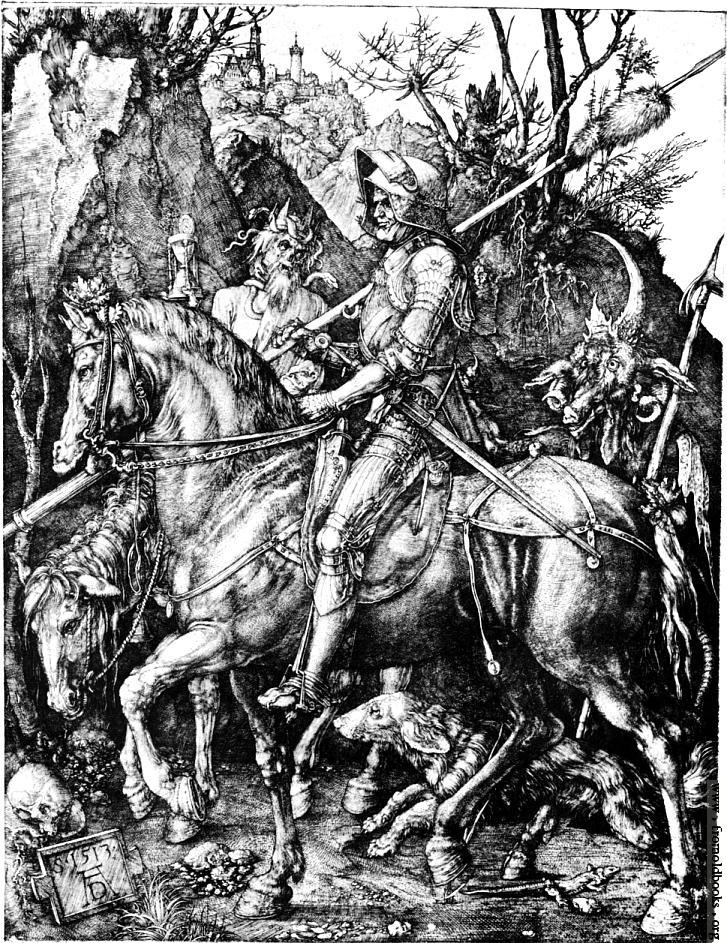
In Spite of Death and the Devil: Husserl–Diary Entry, 9/25/1906

1514-Knight-Death-and-the-Devil-q75-727x943

Pure meditation, pure internal life, being absorbed by the problems and devoting myself to them, and to them only, that is the hope of my future.  If I do not succeed, then I shall have to live a life which is rather death.

…I have to pursue my way so surely, so firmly, so decidedly, and so in earnest as Dürer’s Knight in spite of Death and the Devil…And be God with me in spite of the fact that we are all sinners!

A Bit of Henry Bugbee

Great bit of Bugbee from Ed Mooney’s blog.

Mists on the Rivers--

Tuesday, January 15, 1963


No wind stirs.

At Zero Fahrenheit the flakes of snow are not at all large.

Incredibly lightly and unwaveringly they fall.

A myriad of them  fills our meadow round the house.

One sees them best looking at the trees beyond.

Their falling accentuates the still-standing trees, the dark trunks.

And the still of the trees is the nearness of  falling snow.

Occasiona11y, in the meadow, a weed nods and lifts again.

The low fire on the hearth is even more discreet.


Henry Bugbee, A Way of Reading the Book of Job

View original post

Notebook Fetish, Pen Fetish, …Fetish

Like many folks who write, I am obsessed with notebooks and pens and just about anything else connected with them–pencils, sharpeners and erasers. I am embarrassed to admit that a quick check in my book bag (an entirely different obsession) reveals two smallish, Moleskine-like notebooks, a small sketch pad, a legal pad, a pocket-size notebook (all but the legal pad with graph paper), 2 Sailor fountain pens, 2 Parker fountain pens, 2 mechanical pencils, a Sharpie permanent fine-point marker, 4 pencils, 2 sharpeners, some erasers (I’d have to empty the bag to know how many, exactly), several Sailor ink refills and a pocket-size 2013 calendar. And, of course, on top of all that a copy of Husserl’s Shorter Logical Investigations, Royce’s The Religious Aspect of Philosophy, Plato’s Theaetetus, a Revised English New Testament. –Perhaps carrying all this is the professor’s way of trying to ensure he dies with his boots on.