Terrific Google search page today.
Descartes’ Meditations: Seeking Purity of Mind
I have been teaching Descartes’ Meditations in my Intro class. It is the first time in many years that I have worked past the Second Meditation with any care.
Among the many things that strike me–and I am of course not claiming original insight here–is the way in which Descartes’ epistemological struggle runs parallel to spiritual struggle. Like the acknowledged sinner, Descartes repents, and, in repenting, seeks for a true change of mind. To do this he must, again like the sinner, conduct an agonizing examination of conscience, testing himself at every turn. He makes but fitful progress: lessons learnt are soon forgotten; old habits die very hard. But he keeps at it, keeps salting his beliefs with the fire of doubt, and eventually he purifies himself. He stands naked, vunerable–apparently alone. The purifications of doubt, have, however, done their work–blessed are the pure in heart, in mind, for they shall see God. And Descartes does. He finds that he is not alone: God is with him. And, it turns out, God has been with him all along: though Descartes has been wandering through a valley dark, no evil demon need he fear. God’s shepherd’s crook comforts him. And, so, in the end, much like Job, Descartes gets back what he had before (at least, what he really had). God prepares a table for Descartes before the face of the evil demon, and Descartes’ epistemological cup runs over.

Japanese Christian Orthodox Icon
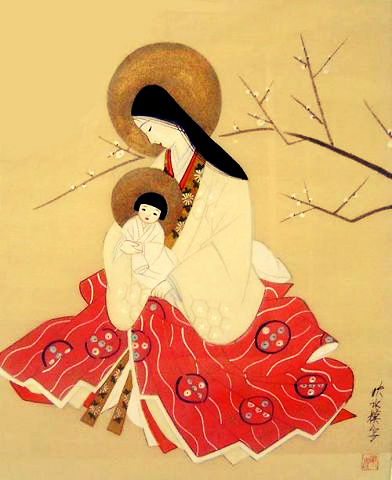
Japanese Christian Orthodox Icon (in the Nihonga style of the late 19th-early 20th century)
Psalm 36 (Mother Maria, trans.)
An oracle for the impious
Is the sin in the deep of his heart.
He regards himself
With an eye too flattering
To discover his guilt
And hate his transgression.
Perfidy and misdeed
He plots upon his bed,
He sets his steps
Upon an evil course,
Heedless of his sin.
The words of his mouth
Are fraud and deceit,
He can no more act
Wisely or well.
…
There, see how the wicked are fallen,
They can rise no more.
Emerson and Montaigne 1
I will begin with a quotation–as I so often do. But–“we are all quotation”–so, why hide it?
This is from Firkins’ strange and compelling book on Emerson. He is addressing the issue of clarity in Emerson.
Dr. Garnett writes of the individual sentence in Emerson: “His thought is transparent and almost chillingly clear.” For most men, the clarity is hardly of the sort that regulates the temperature. It is true, nevertheless, that for Emerson, as for Browning and Meredith, around the fact of obscurity and illusion of greater obscurity has grown up. The trouble with Emerson is more often strangeness than dimness; the indistinctness of the moral Monadnock or Agiochook which he points out to us is due rather to the distance of the peak than to the haze of the atmosphere.
I will let this quotation stand alone for a moment. I will have something to say about it, and about other moments in Firkins, in the next post.
Emerson on Montaigne, a New Start
Last year, around this time, I was writing here about Emerson’s essay on Montaigne. I got distracted from that and moved on to other things. But I am going to get back to it now. Look for more posts in the coming days. In the meantime, you might want to look at the initial post I wrote last year.
Turning East–New Book

Just out from SVS Press. I contributed an essay.
William Temple on Plato’s Vision of the Ideas
To us the Ideal Theory is myth, as it was to Plato in the later period. Prof. Burnet wrote recently of the myths–“They have their roots in something older than philosophy, and possessing a vitality which is denied to philosophical systems.” And just before he had pointed out that Aristotle, who begins with accepted facts and ends in myth, has always been a pillar of orthodoxy, while “most heresies come from Plato” because he insists on scientific treatment of ultimate questions. This is no doubt true; but this distinction is rooted in another. Here, as in all departments of human activity, the ultimate fact is temperament. Aristotle was bound to produce a philosophy which would be a basis for orthodoxy, for, colossal as was his intellect–perhaps the greatest in history, –he was by temperament a churchwarden; and Plato was bound to be the philosophic father of many heretics because he was by temperament a Titan. There is an inspiration in the spectacle of the old philosopher tearing in shreds his proudly built philosophy and beginning it all afresh. But among his actual works what I have called “the old Ideal Theory,” which he himself rightly discarded, is worth more to mankind than the method of division elaborated in the Sophist and the Politicus…[This] may be of great scientific value, but [it imparts] no impulse. The Ideal Theory, as held by Plato in his middle period, may be myth; but it is the outcome and expression of something more valuable than any specific doctrine, however true–of intellectual courage that refuses to allow any sphere to be set beyond the reach of knowledge, of mystic vision in which all that is mean and sordid disappears, and the temperamental fire without which no great achievement is possible in action or art. —Mind 1908 (Vol 17 No 68)
A Few Lines from Frost
Ah, when to the heart of man
Was it ever less than a treason
To go with the drift of things,
To yield with a grace to reason,
To bow and accept the end
Of a love or or a season?
*****
She always had to burn a light
Beside her attic bed at night.
It gave bad dreams and troubled sleep,
But helped the Lord her soul to keep.
Good gloom on her was thrown away.
It is on me by night or day,
Who have, as I foresee, ahead
The darkest of it still to dread.
Another Goodbye to Summer–“Sunbake” (Poem)
Sunbake
Burn
Auburn burn
sunbake redclay
sunbake
The sun doesn’t peer
it stares
and stares
Angry glare, so angry no one
dares
return it
We crouch behind colored lenses
sunbake photogrey
sunbake
“You look to the sun, for he is your taskmaster,
and by him you know the measure of the work
that you have done, and the measure of the work
that remains for you to do”: thus Kinglake.
My daughter, ten or eleven
child of memory eternified: “Dad, it’s hot.”
She hankers for icecream
sunbake milkshake
sunbake
Cooled by the malt
of mercy.
 Quantum Est In Rebus Inane